
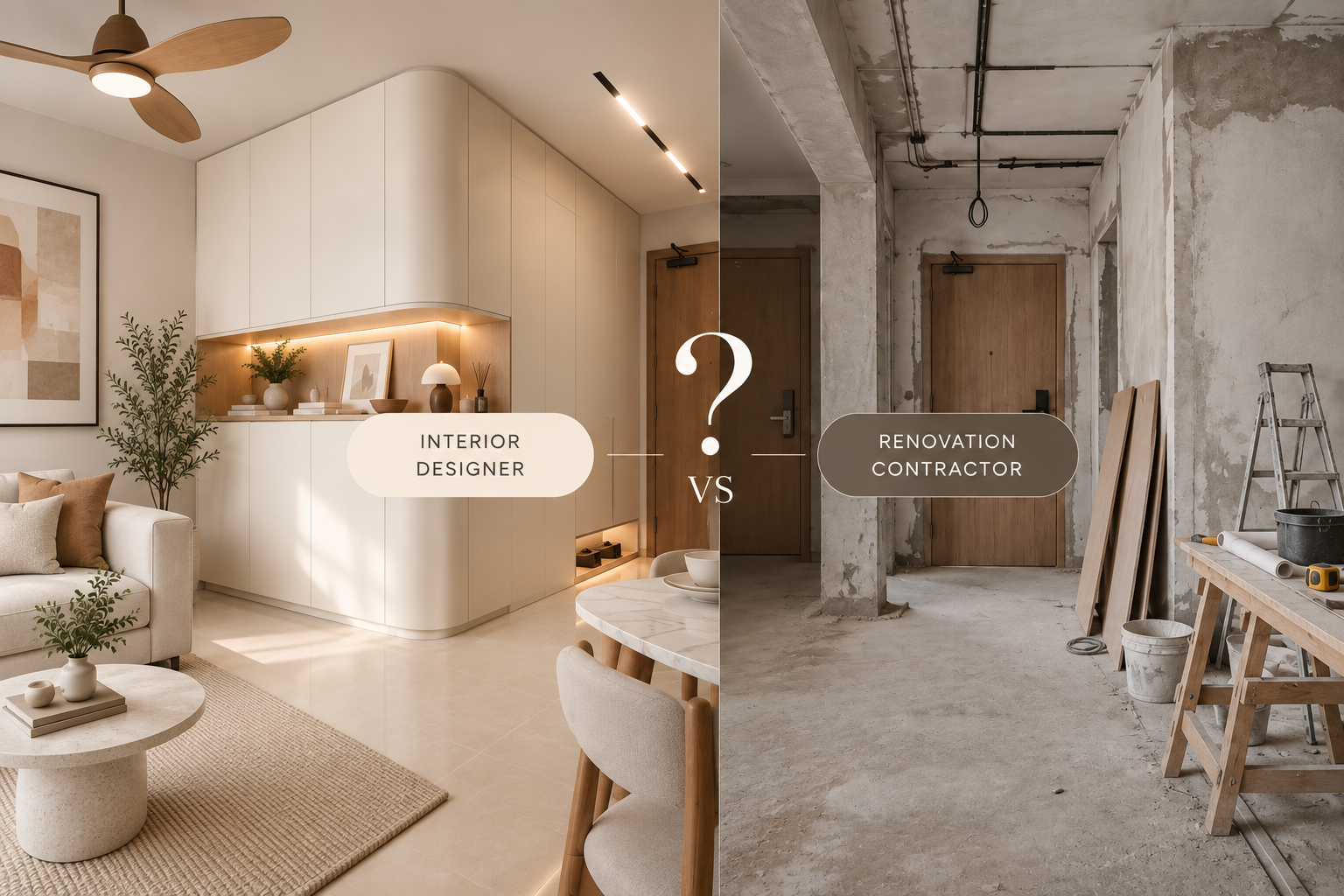
If you are planning a renovation in Singapore, one of the first decisions you may face is whether to hire an interior designer or renovation contractor.
Both can play important roles in a renovation project, but they are not necessarily the same service.
An interior designer generally focuses on space planning, design development, material selection, functionality and the overall look and feel of the space, while a renovation contractor generally focuses more heavily on executing renovation works based on an agreed scope or design.
For homeowners who already know exactly what they want, working directly with a renovation contractor may be suitable. For homeowners who need help developing the layout, design, storage, materials and overall renovation concept, an interior design company in Singapore may provide a more comprehensive approach.
The right choice depends on your property, budget, design requirements and how much involvement you want in managing the renovation.
This guide explains the differences between an interior designer and renovation contractor in Singapore, what each typically does, when you may need one over the other and what to check before signing a renovation contract.
Interior Designer vs Renovation Contractor: The Short Answer
For homeowners looking for a quick answer:
Choose an interior designer if you need help designing the space as well as renovating it.
Consider a renovation contractor if you already have a clear design, specifications and scope of work and primarily need someone to execute the renovation.
However, the distinction is not always absolute.
Some interior design companies in Singapore provide both interior design and renovation/project-management services, while some experienced contractors may also provide practical design suggestions.
The more important question is therefore not simply what the company calls itself.
It is:
What services are actually included in your quotation and who is responsible for each stage of your renovation?
What Does an Interior Designer Do?
An interior designer considers how a space should look, function and respond to the people using it.
For a residential project, this may involve understanding:
- Number of household members
- Daily routines
- Cooking habits
- Storage requirements
- Work-from-home needs
- Children’s requirements
- Furniture preferences
- Lifestyle
- Design preferences
- Renovation budget
The designer then develops a design around those requirements.
Depending on the interior design company, services may include:
- Space planning
- Layout development
- Interior design concept
- Colour and material selection
- Carpentry design
- Lighting planning
- Furniture planning
- 3D visualisation
- Technical drawings
- Renovation quotation
- Contractor coordination
- Project management
- Site supervision
- Defect rectification and handover
The exact scope varies between companies, so homeowners should always confirm what is included.
What Does a Renovation Contractor Do?
A renovation contractor in Singapore generally focuses on carrying out the physical renovation works.
Depending on the company and project, this may involve coordinating trades such as:
- Hacking
- Masonry
- Tiling
- Plumbing
- Electrical works
- Painting
- Ceiling works
- Carpentry
- Glass works
- Doors
- Flooring
- Installation works
If you already have detailed drawings, material specifications and a clear scope, a contractor may be able to quote and execute the required work.
This can be suitable for homeowners who are confident managing design decisions themselves.
However, if you only have a collection of Pinterest images and a rough idea of what you want, there can still be many decisions left unresolved.
For example:
Where should the dining table go?
How deep should the TV cabinetry be?
How much clearance should be left around the bed?
Where should electrical sockets be positioned?
Which kitchen layout works best?
How should storage be distributed throughout the home?
Those are design and space-planning questions rather than simply construction questions.
Interior Designer vs Contractor: Key Differences
Here is a simplified comparison.
| Area | Interior Designer | Renovation Contractor |
|---|---|---|
| Space planning | Usually a core service | May be limited |
| Design concept | Usually included | May not be the main focus |
| Material selection | Usually guided | Depends on contractor |
| 3D visualisation | Often available | Not always |
| Carpentry design | Usually integrated into design | Can execute specified carpentry |
| Renovation works | Often managed/coordinated | Core service |
| Contractor coordination | Often handled for client | Usually manages own trades |
| Project management | Often included depending on company | Varies |
| Best suited for | Clients needing design + renovation | Clients with a defined design/scope |
This table is only a general guide.
Always compare the actual scope offered by individual companies.
When Should You Hire an Interior Designer?
An interior designer in Singapore may be particularly useful when you are starting with an empty floor plan and aren’t sure how to make the space work.
Here are several situations where design assistance can add value.
1. You Don’t Know Which Layout Works Best
A floor plan may allow several possible furniture and carpentry configurations.
The challenge is deciding which one works best for your lifestyle.
An interior designer can explore questions such as:
- Should the kitchen be open or enclosed?
- Where should the dining area be positioned?
- Is an island practical?
- Do you need a full TV feature wall?
- Should a bedroom become a study?
- How much storage should be built?
- How can awkward corners be used?
Good space planning can sometimes improve a home more than expensive materials.
2. You Are Renovating a Small HDB or Condo
Space becomes especially valuable in compact homes.
Poorly planned carpentry can consume valuable floor area.
Oversized furniture can narrow circulation.
Storage can become visually overwhelming.
For HDB interior design or condo interior design in Singapore, an interior designer can help balance storage requirements with open space.
This is particularly important for compact 3-room and 4-room HDB flats and smaller condominium units.
3. You Need Significant Custom Carpentry
Custom carpentry isn’t simply about choosing a laminate colour.
Its dimensions affect the way the room works.
For example, a designer may need to consider:
- Cabinet depth
- Door opening
- Drawer clearance
- Internal storage
- Electrical points
- Lighting
- Furniture relationship
- Walking clearance
- Visual proportions
When several built-in features interact with one another, coordinating them as part of one overall interior design can help create a more coherent result.
4. You Want a Consistent Interior Design
Many homeowners collect inspiration from different homes.
You may like the kitchen from one project, the living room from another and the bedroom from somewhere else.
The challenge is combining those references without creating a home that feels disconnected.
An interior designer can develop a more consistent design language using:
- Colours
- Materials
- Forms
- Lighting
- Carpentry detailing
- Furniture
- Textures
The objective isn’t to copy an inspiration photograph.
It is to understand what you like about it and adapt those qualities to your own home.
When Might a Renovation Contractor Be Enough?
Hiring a contractor directly can make sense in certain situations.
You Already Have Detailed Drawings
If an architect, designer or another professional has already prepared the required drawings and specifications, you may primarily need construction execution.
The Renovation Scope Is Straightforward
For example, you may only need selected works such as:
- Painting
- Flooring replacement
- Basic carpentry
- Minor kitchen upgrading
- Selected bathroom works
A full interior design process may not always be necessary.
You Are Comfortable Making Design Decisions Yourself
Some homeowners enjoy managing their own renovation.
If you can confidently determine layouts, materials, dimensions, lighting and finishes, you may prefer to work more directly with contractors.
But remember that this means you effectively take on part of the design and coordination role yourself.
Is an Interior Designer More Expensive Than a Contractor?
Not necessarily.
This is one of the most common misconceptions about interior design and renovation in Singapore.
A contractor quotation may appear cheaper because the scope is different.
For example, one quotation might include:
- Design development
- Drawings
- Material consultation
- Project coordination
- Custom carpentry
- Renovation works
Another quotation might primarily cover construction.
Comparing only the final numbers would therefore be misleading.
Instead, compare:
Scope + quantities + materials + services + exclusions + final price.
The cheapest initial quotation is not necessarily the lowest final renovation cost either.
Changes made after construction begins can increase costs.
This is one reason careful planning before renovation can be valuable.
Does Hiring an Interior Designer Save Money?
An interior designer does not automatically make a renovation cheaper.
However, good planning can help you allocate the budget more deliberately.
For example, a designer may identify that you don’t actually need:
- A full-height TV feature wall
- Extensive ceiling treatments
- Carpentry in every room
- An oversized kitchen island
- Expensive finishes across every surface
The budget could instead be allocated to areas that matter more to everyday use.
Design isn’t only about adding features.
Sometimes good design means knowing what not to build.
HDB Interior Designer vs HDB Renovation Contractor
If you’re renovating an HDB flat, another important consideration is familiarity with HDB renovation requirements.
Certain renovation works are subject to applicable HDB requirements and some works may require approval or appropriate contractors.
Whether you appoint an interior designer or contractor, make sure the team understands the requirements relevant to your proposed works.
For a new BTO, the focus may be primarily on designing and fitting out the new space.
For a resale HDB, the project may involve additional removal, repair or replacement of existing renovation.
An experienced HDB interior designer in Singapore should therefore consider both the design and the existing condition of the property.
BTO Interior Designer vs Contractor
For a new BTO homeowner, it can be tempting to choose a renovation package immediately.
But first ask what you actually need.
If your requirements are straightforward and you already know the layout you want, a package or contractor-led approach could potentially work.
If you are unsure how to plan the home, an interior designer for your BTO renovation may help you make better use of the floor plan.
This can be particularly relevant for decisions involving:
- Suggested Study areas
- Open kitchens
- Kitchen islands
- Living and dining layouts
- Built-in storage
- Work-from-home areas
- Children’s rooms
- Flexible bedrooms
These decisions affect the way you use the home for years after renovation.
Condo Interior Designer vs Renovation Contractor
Condominium renovation can involve a different set of considerations.
Existing developer finishes may already be present.
The challenge may therefore be deciding what is worth keeping and what should be changed.
A condo interior designer in Singapore may help integrate existing finishes into a new design rather than automatically replacing everything.
For compact condos, careful planning can also help with:
- Storage
- Furniture scale
- Dining arrangements
- Home office areas
- Built-in carpentry
- Visual continuity
Condominium management requirements may also apply to renovation works, so these should be checked before work begins.
What About Commercial Interior Design?
The designer-versus-contractor decision also applies to commercial spaces.
For an office, retail shop, salon, F&B outlet or other business premises, interior design may need to address much more than appearance.
A commercial interior design company in Singapore may consider:
- Customer journey
- Staff workflow
- Brand identity
- Space planning
- Storage
- Lighting
- Reception
- Display areas
- Meeting spaces
- Operational requirements
- Materials and maintenance
For a retail business, for example, a beautiful interior that makes product browsing difficult isn’t successful design.
For an office, attractive meeting rooms don’t compensate for inefficient workspaces.
For commercial projects where customer experience, brand presentation and operational flow matter, design planning can therefore be particularly important.
Design and Build: Another Option
You may also encounter the term design and build company in Singapore.
A design-and-build approach generally brings design and renovation execution together under one company or project team.
Instead of separately appointing a designer and contractor, the client works with a company responsible for both stages.
Potential advantages can include:
- One main point of contact
- Better coordination between design and construction
- Earlier cost discussions
- Easier communication when design changes affect construction
However, the quality of the experience still depends on the company.
The words “design and build” alone do not guarantee good design, workmanship or project management.
You should still evaluate the portfolio, quotation, process and people handling your project.
Interior Design Company vs Freelance Interior Designer
Another choice is between an established interior design company and an individual freelance designer.
There isn’t automatically a right or wrong answer.
Instead, determine who is contractually responsible for:
- Design
- Payment
- Construction
- Site supervision
- Warranty
- Defects
- After-sales service
If the designer is independent but contractors are separately appointed, understand how responsibility is divided.
Clear accountability becomes especially important if something goes wrong during the renovation.
What Should Be Included in an Interior Design Quotation?
A renovation quotation should be detailed enough for you to understand what you are paying for.
Depending on the project, categories might include:
Preliminaries
Site protection, disposal and other project setup items.
Hacking and Demolition
Removal of existing finishes, fixtures or carpentry where applicable.
Masonry
Tiling, screeding and related works.
Carpentry
Kitchen cabinets, wardrobes, TV consoles and other custom-built features.
Electrical
Lighting points, power sockets and related works.
Plumbing
Water-related installation or relocation where applicable.
Ceiling
False ceiling, box-up and related features.
Painting
Walls, ceilings and other specified surfaces.
Glass and Metal
Shower screens, mirrors, glass partitions and other custom items.
The categories will vary from project to project.
What’s important is being able to understand what is included, the quantity and the specification.
Don’t Compare Renovation Quotes by Price Alone
Suppose Company A quotes $45,000 and Company B quotes $52,000.
It is tempting to conclude that Company A is cheaper.
But what if Company B includes:
- More carpentry
- Additional electrical work
- Better specified materials
- More extensive bathroom work
- Design services
- Additional project-management scope
The two numbers are no longer directly comparable.
When comparing an interior design quotation in Singapore, place the quotations side by side and compare line by line.
Look for:
- Missing items
- Different quantities
- Different material specifications
- Provisional sums
- Exclusions
- Optional items
Then ask each company to explain significant differences.
Questions to Ask an Interior Designer Before Hiring
Before signing with an interior design company, ask:
1. Who will actually design my home?
The person conducting the sales consultation may or may not be the person managing the design throughout the project.
2. Who will manage the renovation?
Understand who your main contact will be once construction starts.
3. What does the quotation exclude?
This is just as important as knowing what it includes.
4. How are additional costs approved?
Ask about variation orders before renovation begins.
5. What happens if I change the design?
Understand how design changes affect price and timeline.
6. How will progress be communicated?
Ask how frequently site updates are provided.
7. What happens after handover?
Understand the defect and after-sales process.
8. Can I see relevant completed projects?
Look for projects similar to your property type or design requirements.
How to Tell Whether an Interior Designer Is Actually Listening to You
A good consultation shouldn’t feel like someone is simply trying to sell you a predetermined renovation package.
The designer should ask questions.
For a residential project, these could include:
- Who lives in the home?
- How often do you cook?
- What do you need to store?
- Do you work from home?
- Do you have children?
- Do you entertain?
- What furniture are you keeping?
- What do you dislike about your current home?
- What is your budget?
- What are your priorities?
These questions help transform a floor plan into a home designed around real behaviour.
If the discussion jumps immediately from floor plan to package price without understanding how you live, consider whether enough design thinking is taking place.
What Should You Look for in an Interior Design Portfolio?
Don’t evaluate a portfolio only by whether the photographs look luxurious.
Look more closely.
Ask:
Does the layout make sense?
Is there enough circulation?
Does the storage look usable?
Are different projects actually different, or do they all follow the same formula?
Does the company show projects similar to mine?
If you have a 4-room BTO, an impressive landed-property portfolio doesn’t necessarily demonstrate how well the designer handles compact HDB spaces.
Relevant experience matters.
Should You Choose the Interior Designer With the Best 3D Rendering?
Not necessarily.
A realistic 3D visualisation is useful because it helps homeowners understand the proposed design before construction.
But a beautiful render is still a representation.
Ask about completed work too.
Compare:
Design concept → 3D visualisation → completed project.
You want to know whether the company can translate the design into a real space with good detailing and workmanship.
Common Mistakes When Choosing an Interior Designer or Contractor
Choosing the Cheapest Quotation Immediately
Price matters, but first make sure the scope is comparable.
Signing Before Understanding the Details
Ask questions until you understand what you are buying.
Looking Only at Renderings
Review completed projects where possible.
Ignoring Communication Style
You may communicate with the designer or project manager for months.
Not Discussing Budget Early
A beautiful proposal outside your realistic budget wastes everyone’s time.
Changing the Design Repeatedly During Construction
Late changes can affect both cost and schedule.
Assuming Everything Is Included
If an item matters to you, confirm it in writing.
Interior Designer vs Contractor: Which Is Better for a Tight Budget?
A contractor isn’t automatically cheaper, and an interior designer isn’t automatically more expensive.
For a limited budget, the key is controlling the scope of renovation.
A well-planned renovation could focus expenditure on:
- Essential kitchen work
- Practical storage
- Electrical planning
- Durable materials
- Necessary bathroom works
- Comfortable lighting
Then reduce:
- Decorative feature walls
- Unnecessary carpentry
- Complicated ceiling designs
- Premium materials in low-priority areas
Tell whoever you are considering hiring what your realistic budget is.
Then ask:
“How would you design this home within this budget?”
The answer may tell you more than simply asking for the lowest possible price.
So, Should You Hire an Interior Designer or Renovation Contractor?
There is no universal answer.
Hire an interior designer when you need professional help deciding what should be built, where it should go and how the entire space should work and look.
Consider a renovation contractor when those decisions have already been made and your primary requirement is executing a clearly defined renovation scope.
For many homeowners, particularly those renovating an entire BTO, resale HDB or condominium, the renovation involves both design and construction.
In that situation, working with an interior design company that provides renovation and project management can provide a more integrated process.
What matters most is understanding exactly what you are paying for and choosing a team whose capabilities match your project.
Choosing an Interior Design Company in Singapore
A renovation is a significant investment.
Don’t choose a company because it uses the right buzzwords.
Choose based on whether the team demonstrates an understanding of:
- Your floor plan
- Your lifestyle
- Your priorities
- Your budget
- Your storage requirements
- Your preferred aesthetic
- Your project’s practical constraints
At Crown Interior Design, we provide interior design and renovation solutions for HDB, BTO, condominium, residential and commercial spaces in Singapore.
Our approach begins with understanding how the space needs to function before developing the design around the client’s requirements, preferences and budget.
Whether you are planning a new BTO, renovating a resale HDB, updating a condominium or creating a commercial space, careful planning at the beginning can prevent expensive compromises later.
Frequently Asked Questions
What is the difference between an interior designer and renovation contractor in Singapore?
An interior designer generally focuses on space planning, design, materials, functionality and developing the overall interior concept. A renovation contractor generally focuses more on executing renovation works. However, some interior design companies provide both design and renovation services.
Is an interior designer more expensive than a contractor?
Not necessarily. Prices depend on the scope of services and renovation works included. Compare detailed quotations rather than only the final price.
Do I need an interior designer for an HDB renovation?
Not every HDB renovation requires an interior designer. If you already have a detailed layout, drawings and specifications, you may be comfortable working directly with a contractor. If you need help planning the layout, storage, materials and overall design, an interior designer may be useful.
Should I hire an interior designer for my BTO?
An interior designer can be useful for BTO homeowners who need assistance with space planning, kitchens, storage, carpentry, lighting and developing an overall design. Homeowners with straightforward requirements and a clearly defined design may choose a contractor-led approach.
Can an interior designer manage the entire renovation?
Some interior design companies offer design, renovation coordination and project-management services. The exact scope differs between companies, so confirm what is included before signing.
Is a renovation contractor cheaper for a BTO?
Not automatically. A lower quotation may reflect a smaller scope or different specifications. Compare the actual work, quantities, materials and services included.
What should I check before hiring a renovation contractor in Singapore?
Check the proposed scope, quotation details, relevant experience, material specifications, payment arrangement, timeline, project management, applicable renovation requirements and how additional works or defects will be handled.
How do I compare interior design companies in Singapore?
Compare relevant completed projects, proposed layouts, quotation scope, materials, communication, project management and after-sales arrangements. Avoid making the decision solely on the lowest price.
What is a design and build company?
A design-and-build company generally combines interior design and renovation execution under one company or project team. This can provide a single point of contact for both stages, although services vary between companies.
What should I prepare before meeting an interior designer?
Prepare your floor plan, approximate renovation budget, preferred timeline, appliance requirements, existing furniture you intend to keep, storage needs and several design references. Most importantly, explain how you want to use the space.