
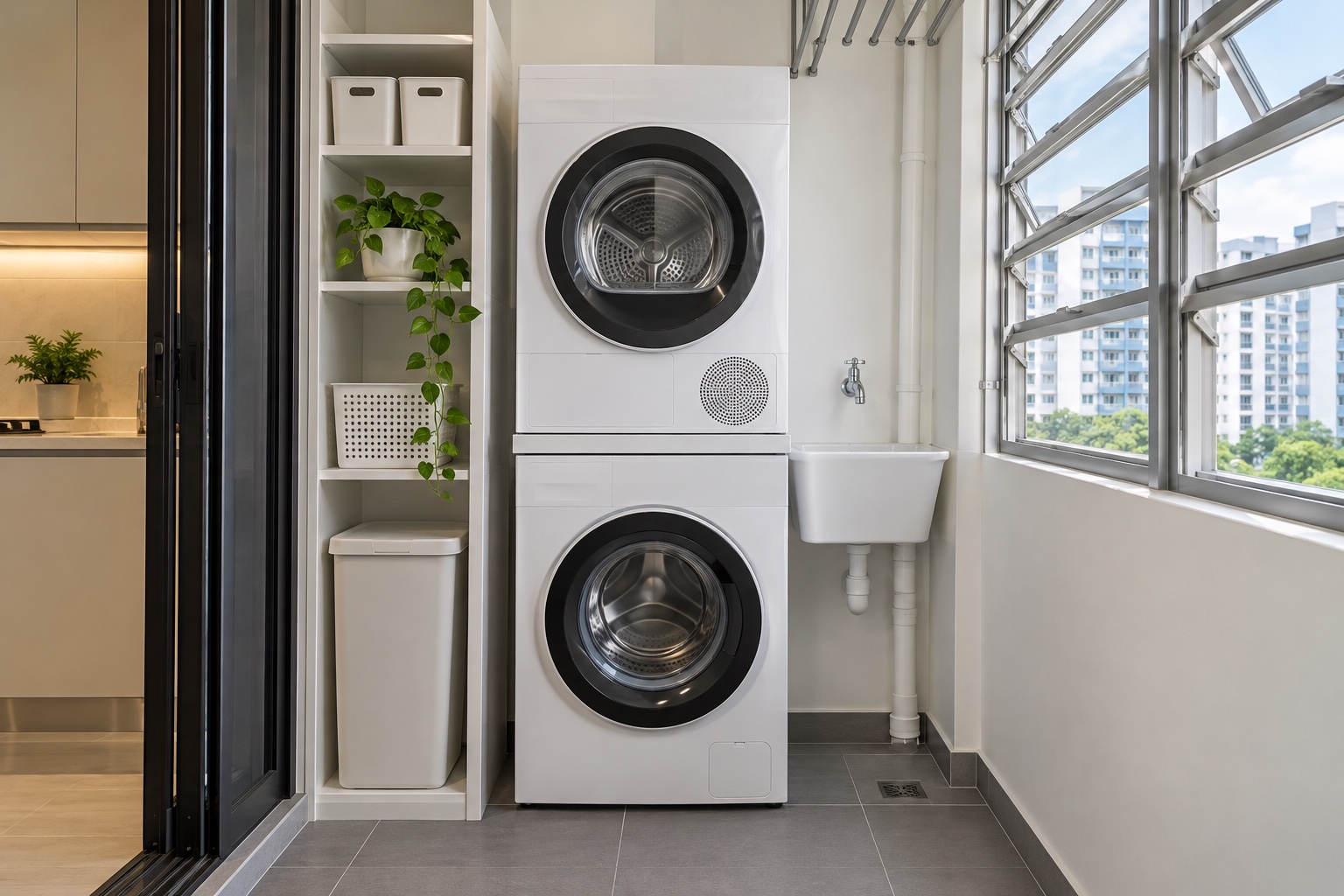
Stacking a washer and dryer can release floor space in an HDB service yard, but similar appliance widths do not establish a compatible stack. Choose the actual models and manufacturer-approved installation arrangement before drawing the surrounding cabinetry. This article addresses the stacked installation decision; Crown's service-yard guide covers the wider laundry route.
Featured image: AI-generated design concept; not a completed Crown project or an approved technical drawing.
1. Verify the exact appliance combination
Give the supplier both model numbers, including any appliance you plan to retain. Ask for written confirmation of a compatible arrangement and stacking kit. Bosch's Singapore guide, for example, matches dryer models to specific kits; that table should not be generalised to other brands or models.
An apparently matching pair still needs product-specific confirmation.
2. Assess the installation position
Have the supplier check the intended floor and location against the appliance instructions. Record available height, door position and relevant services. Avoid treating a cabinet as a substitute for a suitable appliance support and stacking arrangement.
Leave lifting and securing the appliances to an appropriate installer rather than improvising a platform or restraint.
Place the appliance arrangement within the wider service-yard plan in 7 Service Yard Renovation Tips for Singapore HDB Homes.
3. Draw doors, drawers and filters open
Show the washer door, detergent drawer, dryer door and serviceable parts in use. Check a laundry basket on the floor and the user's position in front. A narrow aisle can become impractical once the lower door is open.
Confirm access to any condensate container or other maintained component on the chosen dryer.
4. Follow the ventilation and clearance instructions
Identify the actual dryer type and the conditions its manufacturer specifies. Do not assume all dryers require the same enclosure or venting arrangement. Have the cabinet design checked against the appliance instructions.
A full-height closed cupboard may look tidy but should not be ordered before heat, air and service-access requirements are resolved.
For doors, shelving and connection access around the tower, read Laundry Cabinets: 6 Singapore Space-Planning Checks.
5. Keep connections and isolation reachable
Coordinate electrical and water connections with the responsible installers. Mark which valves, outlets or service points must remain accessible after cabinetry is fitted. Ask how the assembly will be disconnected for maintenance.
Do not position fixed shelves or tightly packed storage where they prevent the required access.
6. Check loading comfort at both levels
Try the approximate height of the upper appliance and consider the people using it. A stacked arrangement releases floor area but raises the dryer opening and controls. Compare it with side-by-side equipment or a different laundry strategy if reach is difficult.
Convenience should be assessed through loading and unloading, not just the floor plan.
Plan drying capacity alongside the appliances with Laundry Drying Racks: 7 Singapore Renovation Checks.
7. Plan delivery and future replacement
Measure the route through the flat as well as the final niche. Identify which panels or shelves can be removed and who can move the appliances safely. Consider what happens when one machine needs replacement before the other.
A cabinet built too closely around one exact pair may make a later compatible arrangement harder to accommodate.
8. Confirm the complete supplier scope
List the appliances, correct kit, delivery, installation, old-equipment removal and any separately arranged services. Ask for a demonstration and the relevant manuals at handover. Keep model and kit numbers together.
Any change of appliance after cabinet sign-off should be checked before the fabricator proceeds.
A practical planning example
The following is a hypothetical planning scenario. A family has a working washer and wants to place a new dryer above it. The design brief should begin with the retained washer's model, not a generic stacked rectangle.
If the supplier cannot confirm a suitable combination, the family can compare a new compatible pair with a side-by-side arrangement. They should also test how the upper door is reached and whether the cabinet allows later removal. Stacking is an option to assess, not an automatic upgrade for every small yard.
Compare the scope before committing
| Option | When to consider it | What to confirm |
|---|---|---|
| Stacked pair | Releases floor area | Compatibility, upper reach and removal |
| Side by side | Keeps both openings lower | More floor width needed |
| Washer-dryer combination | One appliance footprint | Check the actual household cycle needs |
References for your renovation brief
Check the current guidance and the exact product or premises requirements with the responsible professional. Product examples below do not establish compatibility for every brand or model.
Frequently asked questions
Can I stack different brands?
Do not assume compatibility. Obtain confirmation from the relevant manufacturers or suppliers for the exact combination and installation method.
Can cabinetry hold the dryer instead of a kit?
Use the appliance manufacturer's approved arrangement. Have any proposed support assessed rather than treating ordinary cabinetry as equivalent.
For a real Crown residential interior reference, explore 178C Hougang Citrine. Its portfolio photographs are separate from the conceptual illustration in this guide; they do not demonstrate every product or installation discussed here.
Discuss your renovation scope with Crown
Send Crown your service-yard photographs and the exact appliance models to discuss the renovation scope and request a quotation. Start with Crown’s interior design services, or contact the team with your brief. Confirm site conditions, specialist responsibilities and the agreed work before ordering.