
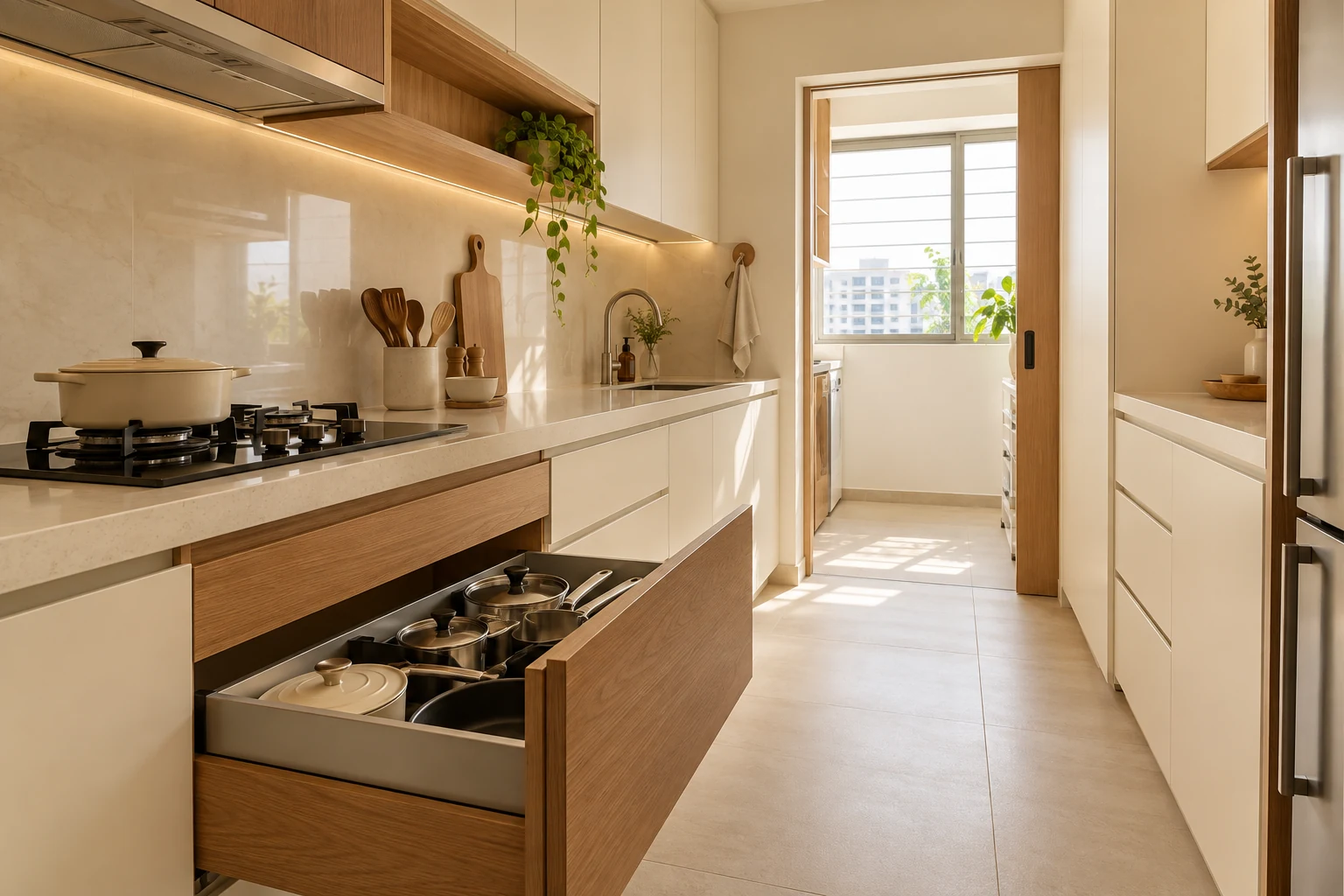
Kitchen drawers bring stored objects towards you, while a cupboard can provide flexible shelf space behind a door. The right base-cabinet mix depends on what you store and how you use the kitchen, rather than a rule that every lower unit should have the same mechanism.
For a Singapore renovation, compare the actual cabinet internals before approving the exterior design. A run of identical fronts can conceal very different useful capacity and hardware requirements.
1. Group items by task and size
Separate cookware, plates, cutlery, cleaning supplies and occasional appliances. Measure the largest items in the position they will be stored. A deep pot drawer may work well for heavy cookware, while a tall appliance may need a different compartment. Put frequently used objects close to the relevant preparation or cooking area without assuming the whole kitchen must be arranged around one standard template.
2. Compare reachable space rather than gross volume
A cupboard may appear to have more empty space, but objects at the back can be awkward to reach. Drawers can improve visibility while losing some internal space to the box and runners. Ask for usable dimensions and test them against the contents. The choice is not simply capacity versus convenience: internal shelves, trays and dividers can alter the balance for either arrangement.
3. Review hardware for the intended use
Identify the runner or hinge system, its intended loading and its replacement route. Soft-close is one feature, not a complete specification. Heavy cookware and frequent use should be part of the discussion with the supplier. Ask for a demonstration of the selected arrangement where practical. Do not assume a drawer shown in a different size or finish will perform identically to the proposed unit.
4. Coordinate appliances, corners and services
Check drawers fully extended beside the dishwasher, oven, refrigerator and adjoining doors. A sink base may need a different arrangement because plumbing occupies space. Corners can create collisions or inaccessible sections if considered only after the external design is fixed. Use the actual appliance information and a coordinated plan to resolve these interfaces before fabrication rather than relying on a perspective image.
5. Consider the users and cleaning routine
Compare the actions needed to retrieve everyday objects: reaching, bending, opening a door or lifting a stack. The appropriate arrangement depends on the users and their preferences. Ask how drawers and shelves can be removed for cleaning and maintenance. Avoid adding intricate organisers that are difficult to clean or replace unless they solve a clear problem for the household.
6. Price the same internal arrangement
Two quotations for the same cabinet length can contain different drawer counts, shelf divisions and hardware. Request a comparable specification showing the actual internals and any accessories. Identify exclusions such as countertop work, appliance coordination and removal of existing cabinetry. If reducing cost, discuss which compartments can use simpler storage while preserving the drawers that provide the most daily benefit.
Compare the practical options
| Option | Useful when | Resolve before approval |
|---|---|---|
| Deep drawers | Cookware needs visible, direct access | Usable dimensions and specified loading |
| Shelved cupboards | Larger or varied objects suit flexible divisions | Reach to the back and shelf spacing |
| Mixed base units | Different tasks need different storage | Coordinated internals and a comparable quote |
A planning example
A homeowner proposes drawers throughout a kitchen because they look convenient. The inventory includes tall cleaning equipment beneath the sink and a bulky occasional appliance. Those items may be better in appropriately planned cupboards, while daily cookware benefits from selected drawers. The final mix follows the contents and services. This is a planning example, not a completed Crown Interior Design project or a universal cabinet specification.
Frequently asked questions
Are drawers always more expensive?
Compare the selected hardware, construction, drawer count and complete scope. A universal price rule is not a useful substitute for equivalent quotations.
Can a cupboard be converted to drawers later?
It depends on dimensions, door openings, services and cabinet suitability. Ask a competent fabricator to assess the existing unit.
How many drawers should a kitchen have?
Start with the items and tasks. There is no one drawer count that suits every flat or household.
Related planning: Kitchen Cabinet Design Singapore: Layout & Storage Guide · Renovation Drawings: 7 Checks Beyond the 3D Render.
Explore the related decision in Kitchen Pantry Cabinets: 6 Singapore Planning Checks.
Discuss your project with Crown Interior Design
Send your floor plan, current photographs, intended use, timing and spending priorities. Explore Crown Interior Design’s services and residential projects, then request a tailored quotation. Confirm the proposed scope and any specialist involvement for your actual premises.