
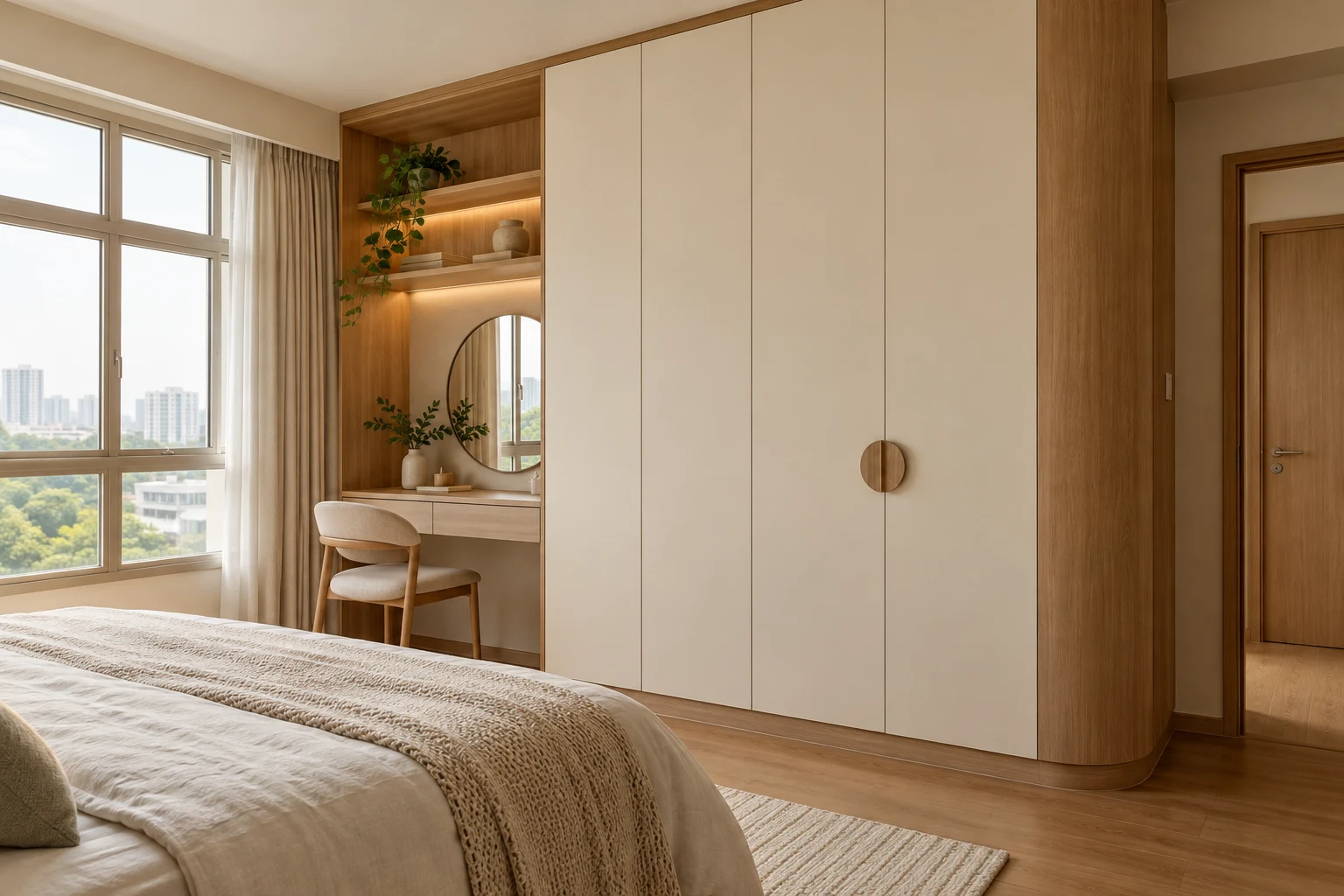
“Plywood or MDF?” is an incomplete carpentry specification. Both names describe families of products, and the intended application, grade, construction and finish matter. A cabinet body, a painted door and an exposed decorative panel do not necessarily need the same solution.
For a Singapore renovation, ask what is proposed for each component and why. Avoid blanket claims that one board name guarantees waterproofing, strength or a particular service life. Compare documented products and the way they will be used.
1. Separate the substrate from the finish
A laminate or veneer is not the same thing as the board beneath it. Ask the quotation to identify the proposed core material and finish separately for cabinet bodies, doors, shelves and exposed panels. Similar-looking external surfaces can conceal different constructions. The existing laminate-versus-veneer guide addresses appearance and finish choices; this comparison focuses on specifying the underlying board for its role.
2. Match the product to the component
Ask why the selected board suits a door, shelf or cabinet body. Consider the intended span, load, fixing and surface treatment with the fabricator. A product suited to a smooth painted front may not be the right assumption for every wet-adjacent cabinet component. Supplier technical information should support the proposed application; a generic statement that all MDF or all plywood behaves identically is insufficient.
3. Describe moisture exposure honestly
Distinguish an ordinarily dry bedroom cabinet from a kitchen area exposed to spills or a bathroom adjacent to plumbing. Moisture-resistant terminology does not by itself mean a complete cabinet can tolerate standing water or an unresolved leak. Ask for the actual product classification, edge treatment and installation detail. Investigate existing dampness before enclosing it, and keep routine water exposure and maintenance in the discussion.
4. Check hardware and construction together
Hinges, runners and supports rely on a suitable assembly, not only a material label. Ask the fabricator to coordinate the selected hardware and fixing method with the board and intended use. Review large doors, long shelves and concentrated loads particularly carefully. Do not transfer a load rating or installation detail from one board product to another without the relevant supplier confirming suitability.
5. Request identifiable product information
Record the manufacturer or product reference where available, relevant grade, thickness and any emissions classification being specified. A classification should be backed by the applicable documentation rather than treated as a vague health promise. EGGER’s published MDF product information illustrates why technical data is product-specific; it does not establish that Crown Interior Design uses that supplier or that the same data applies to a different board.
6. Compare equivalent quotations and samples
Ask which components use which construction, how exposed edges are finished and what substitutions require approval. Compare the same internal layout and hardware before attributing a price difference to board choice. A physical sample can help you understand the finish and edge, but it does not certify the whole cabinet. Retain the written specification, approved samples and care instructions for the installed product.
Compare the practical options
| Option | Useful when | Resolve before approval |
|---|---|---|
| Plywood-based component | The specified product and assembly suit the intended role | Grade, thickness, finish and moisture detail |
| MDF-based component | The selected product suits the surface and construction brief | Product classification and application limits |
| Mixed construction | Different components have different requirements | A component-by-component schedule |
A planning example
A homeowner compares two wardrobe quotations, one labelled plywood and one MDF. Before choosing, the household should establish whether the labels describe the whole unit or only particular parts, and compare door construction, shelves, hardware and finish. A documented component schedule is more useful than a headline material preference. This is an illustrative procurement exercise, not a laboratory test or a claim about a completed Crown Interior Design project.
Frequently asked questions
Is moisture-resistant board waterproof?
Do not assume so. Check the actual product documentation and complete installation detail, including edges and joints. Address leaks and standing water separately.
Can one cabinet use several board types?
It can, where each component is appropriately specified. Ask for a clear schedule rather than assuming a single material throughout.
Does a sample prove emissions performance?
No. Request the relevant product documentation for any classification being offered; appearance alone cannot establish it.
Related planning: Custom Carpentry Singapore: Built-Ins & Quotation Guide · Laminate vs Veneer: 7 Singapore Carpentry Decisions.
References
Explore the related decision in Renovation Material Selection: 6 Sample Approval Checks.
Discuss your project with Crown Interior Design
Send your floor plan, current photographs, intended use, timing and spending priorities. Explore Crown Interior Design’s services and residential projects, then request a tailored quotation. Confirm the proposed scope and any specialist involvement for your actual premises.