
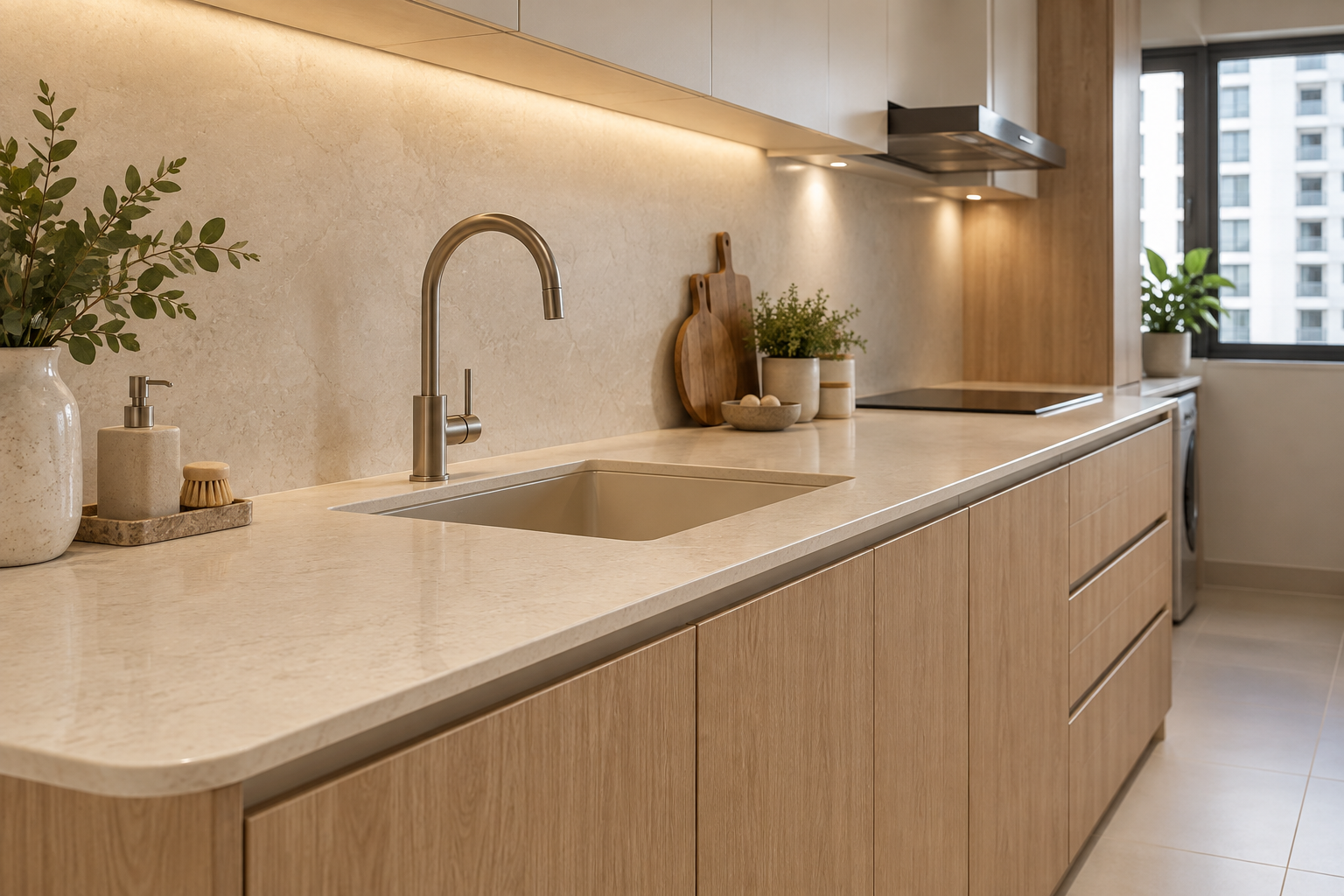
Choosing a kitchen countertop in Singapore involves more than selecting a convincing marble pattern. The worktop has to suit your cooking, cleaning habits, sink, appliances and cabinet support. A small sample cannot show every joint, exposed edge or cut-out that will appear in your finished kitchen.
Quartz, sintered surfaces, solid surface and natural stone are material families, not interchangeable specifications. Exact product guidance matters. Use the following eight checks to compare proposals without assuming that a premium label means the surface is impossible to stain, chip or damage.
By Crown Interior Design. Planning guidance for Singapore homes; the final scope should follow a site assessment.
1. Identify the exact product
Ask for the manufacturer, collection, colour, thickness and finish, not just the word quartz or stone. Different products in the same family can have different fabrication and care requirements. Keep the approved sample and product details with the quotation. If a substitute is proposed later, review it as a new selection. A photograph of a similar pattern does not establish that the supplied slab has the same properties or visual character.
2. Match the surface to daily habits
Consider frequent cooking, coffee preparation, food colouring, acidic ingredients and how quickly spills are normally cleaned. Ask the supplier for written care guidance for the exact product. Do not accept blanket claims that a surface is scratch-proof or maintenance-free. Using boards and appropriate heat protection is a sensible way to reduce risk, but follow the manufacturer’s specific instructions. Choose a finish you can live with rather than one that requires routines the household will not maintain.
3. Compare material families fairly
Engineered quartz offers a wide range of controlled patterns, while sintered surfaces offer a different composition and fabrication process. Acrylic-based solid surface can suit particular joint and shaping requirements; natural stone brings individual variation and product-specific care. None of these brief descriptions is a performance guarantee. Compare named products, warranties and installer requirements side by side. Ask how the proposed surface behaves at edges and cut-outs as well as across the flat top.
4. Plan joints before approving a pattern
A dramatic vein may look continuous on a rendering but need a visible joint in fabrication. Ask for the proposed joint locations on the plan, especially at corners and long runs. Check whether the pattern direction changes and where the joint sits relative to the sink. Acceptable layout depends on slab dimensions, access and fabrication constraints. Resolve this before purchase so the installer is not choosing the most visible detail without your input.
5. Check edge details and support
A thin-looking edge, thick-looking edge and curved profile may involve different fabrication. Confirm what the quotation actually includes. Overhangs and unsupported sections need assessment by the fabricator rather than a copied dimension from an inspiration image. Discuss vulnerable corners, particularly beside an entrance or busy passage. A restrained profile can be a better choice than a complex edge if it improves usability, repair options or alignment with the cabinet doors.
6. Coordinate the sink and hob
Choose the actual sink and hob before the worktop is cut. Their installation requirements affect openings, support and the available preparation space. Ask who provides the templates and who takes responsibility for a mismatch. Consider the faucet position, any additional fittings and access to connections below. A sink that fits within the overall counter length may still conflict with the cabinet internals. Review the top and base drawings together rather than as separate purchases.
7. Price the installed result
Compare supply, fabrication, delivery, cut-outs, edges, joints, installation and removal of the old top where applicable. For replacement work, ask whether the existing cabinets can be retained and what might be affected during removal. Keep backsplash and plumbing reinstatement visible. A low supply rate is difficult to compare with an installed quotation that includes complex fabrication. Record what happens if site conditions require extra support or a changed joint arrangement.
8. Inspect and keep the care information
At handover, check the approved colour, finish, joint layout and edge workmanship against the agreed scope. Record any concern promptly with photographs rather than trying an abrasive treatment. Obtain the warranty and care instructions, including which party handles fabrication issues. Keep the product identifier for future enquiries. A worktop should be chosen as part of the kitchen system, with cleaning, access and replacement considered alongside its first-day appearance.
Compare the options before committing
| Decision | What to confirm | Detail to resolve |
|---|---|---|
| Quartz | Exact product, finish and heat-care instructions | A generic claim that all quartz behaves identically |
| Sintered surface | Fabrication, edges and cut-out detailing | Assuming damage is impossible |
| Solid surface | Product composition, joints and approved cleaning | Expecting every stain or mark to be repairable |
| Natural stone | Individual slab, finish and maintenance guidance | Choosing only from a small digital swatch |
A practical planning example
For an illustrative BTO kitchen with a corner run and undermount sink, two similar-looking worktops may have different joint proposals. The more useful comparison is the installed drawing, named product, care requirements and complete price. If one option places a conspicuous joint beside the sink while another changes the slab layout, that detail may matter more to the owner than the promotional material name.
What to bring to your design consultation
- Cabinet drawing and exact sink/hob models
- Product identity, finish and edge profile
- Joint layout and support responsibilities
- Installed price, care instructions and warranty
Ask for drawings and an itemised proposal that separates confirmed work from assumptions. Compare the complete installed scope rather than a promotional starting price. Explore Crown Interior Design’s renovation and interior design services and residential portfolio to help explain the direction you prefer.
Frequently asked questions
Which countertop is best for a Singapore kitchen?
There is no universal winner. Compare exact products against your cooking, appearance, fabrication, care and budget requirements.
Can I replace only the worktop?
Possibly, but first assess the base cabinets, removal method, backsplash interfaces and service reconnections. Retention should not be assumed without inspection.
Should I match the backsplash exactly?
It is optional. A related colour can create continuity without repeating a strong pattern. Review the two surfaces together under the proposed lighting.
Plan your next step with Crown Interior Design
Share your floor plan, photographs, preferred move-in timing and budget priorities. Request a renovation quotation from Crown Interior Design so the discussion starts with your actual home and scope.
Related reading: Kitchen renovation singapore · Kitchen cabinet design singapore.
For a related planning checklist, see RenoLinkUp’s guide to measurements before fabrication. For applicable requirements or product guidance, consult the relevant official guidance and confirm details for your proposed work.