
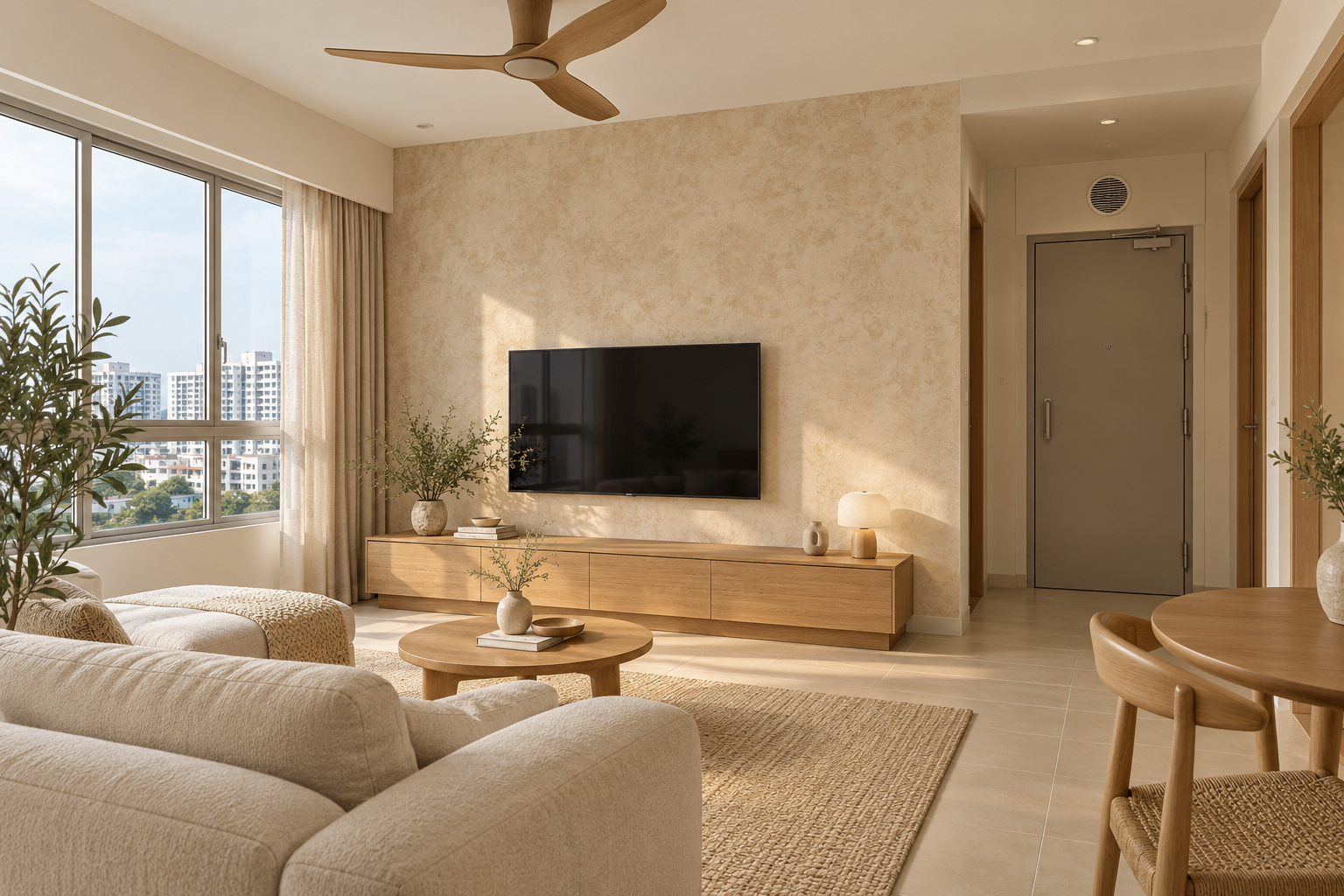
Limewash paint can give a Singapore interior a soft, varied wall finish, but the name does not identify one interchangeable product. A mineral limewash and a decorative coating that imitates its appearance can need different preparation and care. Start with the exact product and wall condition, then decide whether the effect suits the room.
This guide concerns finish selection within a renovation, not a do-it-yourself application recipe. A textured appearance is not evidence of waterproofing, mould treatment or a healthier home. Follow the named manufacturer’s instructions and obtain appropriate advice for the actual surface.
By Crown Interior Design. A planning guide; the final design and scope depend on the actual premises.
1. Identify the product behind the name
Ask for the brand, product name and technical information. Some products use mineral lime; others recreate the visual effect. Nippon Paint describes its Momento Limewash Effect as a water-based decorative coating that imitates traditional limewash. That description does not apply to every product in the category. A quotation should identify the selected system so preparation, appearance and maintenance can be compared on the same basis.
2. Assess the wall before choosing colour
Have the applicator review the substrate, existing coatings and visible concerns. A surface that looks smooth in a photograph may still need preparation. If staining or dampness is present, establish the cause and suitable treatment rather than expecting a decorative coating to conceal it. Ask what can be assessed before work and what remains uncertain. A new finish should not make a condition harder to inspect or address.
3. Approve a useful physical sample
Request a sample made with the proposed product and application approach. A small colour card cannot show the variation across a wall. Review it beside the actual flooring, cabinetry and fabrics. Keep an approval record while recognising that a hand-applied finish has variation. Agree how the sample guides the work without expecting a wall identical to a digital reference. Ask whether the sample cost and revisions are included.
4. Review it under the intended light
Observe the sample in daylight and the planned evening lighting. Light grazing the wall can emphasise variation, while frontal light changes the effect. A warm beige chosen in a showroom may look different beside your window. Review the complete palette rather than the wall alone. If a strong texture is selected, quieter cabinets and fabrics may produce a more coherent room than several competing patterns.
5. Choose the location by daily use
A sheltered bedroom wall has different demands from a narrow entrance or food-preparation area. Ask the supplier to confirm the named product’s suitability and cleaning requirements. Do not assume every limewash-style finish is equally washable. A conventional finish in a related colour may be more practical in a high-contact location. The design should support the household’s actual maintenance routine rather than require habits it will not sustain.
6. Follow system-specific care advice
Do not add a generic sealer because another homeowner recommends it. Bauwerk, for example, advises against protective top-coat sealers over its limewash; another system may have different instructions. Obtain written guidance on cleaning, touch-ups and repainting for the chosen product. Keep it with the handover records. Similar appearance does not establish compatibility between products, so confirm changes with the supplier rather than mixing methods from unrelated online tutorials.
7. Coordinate the work sequence
Agree when wall preparation, cabinetry, electrical fittings and decorative application happen. Include protection and the treatment of corners and returns. Ask who resolves damage if another trade marks the wall later. A specialist finish should have a defined area and sequence, not an unexplained allowance at the end of the programme. Resolve access to switches and lights before application so later adjustments do not create avoidable rework.
8. Compare the complete proposal
The price should describe the product, preparation, sample, extent, labour, protection and excluded repairs. Ask how additional preparation is approved if conditions differ from the initial assessment. Compare the installed result and upkeep rather than a rate alone. One feature wall may be more useful than a whole-home treatment. Crown Interior Design can coordinate the finish with the wider palette and scope without treating it as a universal solution.
A comparison to use in your brief
| Decision | Question to resolve | Evidence to request |
|---|---|---|
| Product | Exact system and technical guidance | A generic limewash label |
| Sample | Variation beside actual materials | Colour viewed only on a phone |
| Location | Contact and cleaning demands | One system used everywhere |
| Care | Manufacturer-specific instructions | An unverified universal sealer |
A practical planning example
An illustrative BTO living room can pair a warm mottled wall with plain cream cabinetry and oak furniture. The physical sample may show that a subtler texture suits the room better than the dramatic reference image. A nearby high-contact passage could use a more suitable conventional finish in a related colour, preserving the palette without applying one system indiscriminately.
Prepare a useful enquiry
- Wall photographs and condition information
- Named product and preparation/care guidance
- Physical sample under room lighting
- Defined scope and repair responsibilities
Frequently asked questions
Are limewash and limewash-effect paints the same?
No. Similar appearance does not establish identical composition, preparation or maintenance. Check the named product.
Will limewash fix damp or mould?
Do not use a decorative finish instead of assessing and addressing an underlying condition.
Must every finish be sealed?
No universal instruction applies. Follow the exact manufacturer’s guidance and confirm compatible products.
Discuss the scope with Crown Interior Design
Share your floor plan, site photographs, intended use, timing and budget priorities. Explore Crown Interior Design’s interior design and renovation services and residential projects, then request a project quotation.
Related Crown Interior Design guides: Wabi sabi interior design singapore · Minimalist interior design singapore.
For a related planning checklist, read RenoLinkUp’s guide to approving a finish sample before repetition.
Source reference: Relevant property, product or planning guidance. Confirm current requirements with the appropriate parties for your actual property and proposed works.
Product-specific example: Bauwerk’s guidance on top-coat sealers. Apply advice only to the system for which it is intended.