
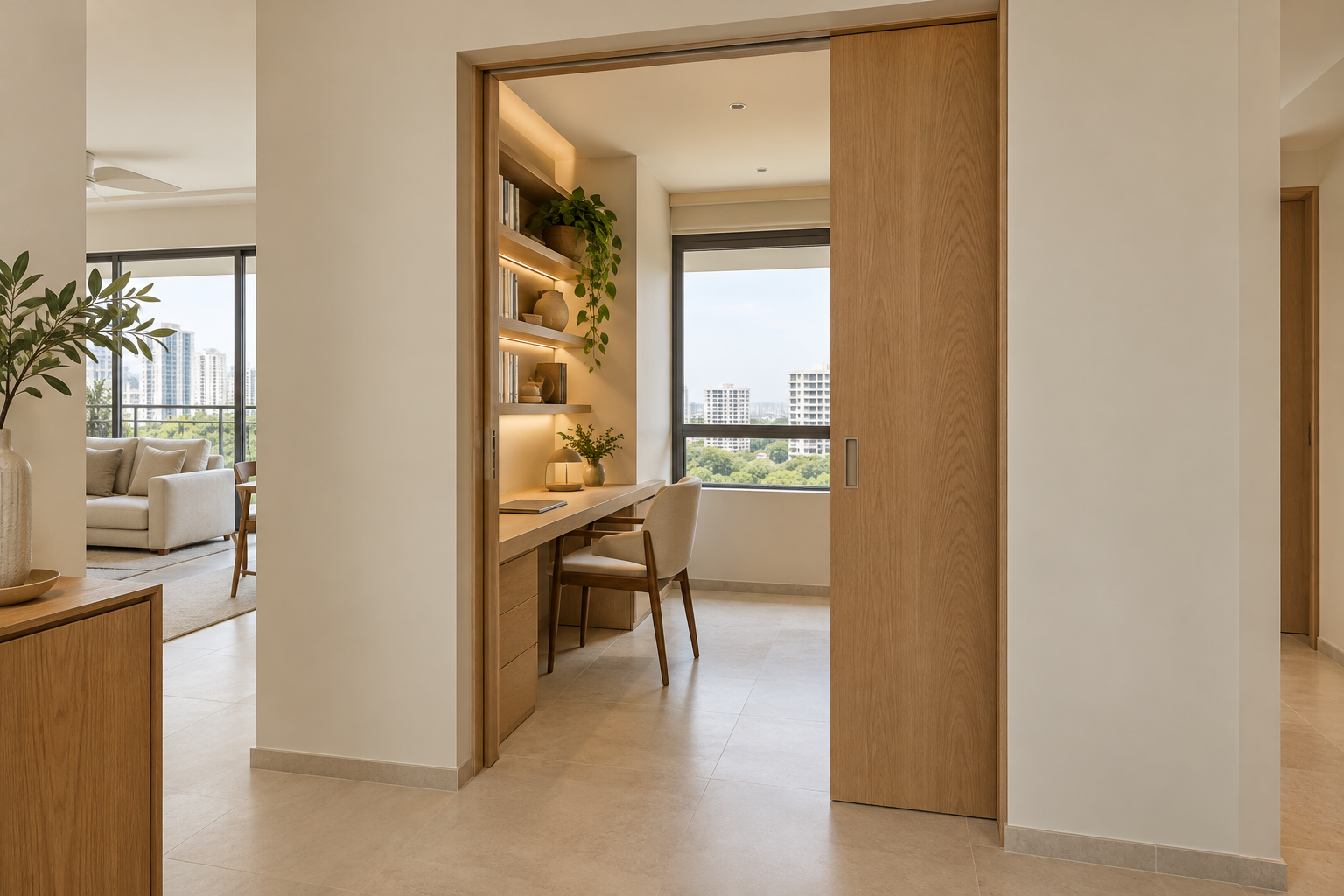
A pocket door slides into a cavity rather than parking against the face of an adjacent wall. That can be useful where door swing or visible panel parking conflicts with furniture, but it also makes the wall and maintenance arrangement part of the product decision. The hidden leaf still needs a properly specified place to go.
This Singapore guide focuses on whether a pocket system suits an interior opening. It complements a kitchen sliding-door guide by examining the cavity and access trade-offs. Confirm feasibility, property requirements and the actual system with the responsible parties before ordering.
1. Describe the problem with the existing door
Identify whether the issue is swing space, a blocked wall or the relationship between two activities. Compare a pocket arrangement with an ordinary sliding or hinged option on the same plan. A more concealed mechanism is not automatically a better solution. Show furniture and nearby doors operating. The benefit should be clear enough to justify the additional wall coordination rather than follow only from a reference with an invisible door.
2. Check the actual wall and opening
Have the relevant team assess the wall, proposed cavity and any affected structure or services. Do not assume an existing wall can be hollowed out or altered freely. A product catalogue cannot establish feasibility for your home. Confirm required approvals and professional responsibilities before fabrication. Keep the actual opening and adjacent conditions recorded so the door supplier and renovation team work from the same information.
3. Compare clear passage rather than frame size
Ask how much usable opening remains with the selected system fully open. Review handles, stops and the actual position of the leaf. Carrying furniture or equipment through the opening may matter as much as everyday walking. Confirm final measurement responsibilities. A nominal door width is not enough to establish practical access, especially where a compact room relies on one opening for delivery and ordinary movement.
4. Reserve maintenance access
Ask how the track, rollers and other working parts can be adjusted or replaced. The system should not depend on permanently inaccessible hardware hidden behind finished carpentry. Request product and servicing information for the actual model. Coordinate access with the wall finish and any nearby cabinets. A clean closed-door elevation is only one part of the decision; the installation also needs to remain understandable and serviceable after handover.
5. Coordinate switches and fitted work
Show the cavity, sockets, switches, shelves and adjacent cabinets together. Do not leave one trade to discover a conflict after another has installed its work. Electrical alterations need the appropriate licensed-worker involvement. Confirm what can be fixed to the surrounding construction and how the chosen system affects the detail. A wall that looks available on an interior elevation may have different constraints once the pocket assembly is defined.
6. Set realistic separation expectations
Explain whether you need visual privacy, acoustic privacy or simply occasional separation. Do not assume a pocket door provides an airtight or soundproof enclosure. Ask for evidence relevant to the actual assembly where performance matters. Review how the door closes, latches and operates for the household. A demonstration is more useful than a broad space-saving claim that ignores the way the room will be used.
7. Specify the completed installation
Include the named door system, leaf, hardware, cavity construction, finishes, removal and making good. Clarify warranty and servicing responsibility. At handover, operate the door with adjacent furniture and doors in use and retain the product information. Crown Interior Design can discuss the interior benefit and coordination, with technical feasibility confirmed for the exact opening. Choose the mechanism because it solves a real problem, not because its working parts are out of sight.
Compare the options before committing
| Option or decision | Useful when | Check before approval |
|---|---|---|
| Pocket system | A concealed parking position adds clear value | Wall feasibility and service access |
| Surface sliding system | The adjacent wall can accommodate the leaf | Parking conflicts and usable passage |
| Hinged alternative | The swing works with the room | Occupied furniture and access |
A worked planning example
An illustrative study has a hinged door that conflicts with a desk. A pocket proposal appears useful, but the team must first assess the wall and services. Moving the desk or using a different door arrangement may be simpler. Comparing all options with the actual furniture prevents a mechanism choice from becoming a reason to approve unexplained wall work. This is not a construction or alteration permission.
What to bring to the design discussion
- Measured opening and current wall photographs
- Furniture and door-operation plan
- Actual system and servicing details
- Property requirements and complete installation scope
Frequently asked questions
Can a pocket door fit any existing wall?
No. The actual wall, structure, services and system need assessment.
Does it make a room soundproof?
Do not assume that. Specify the required separation and assess the actual assembly where performance matters.
Is it the same as a surface sliding door?
No. The parking position and construction interfaces differ, so compare the complete installed options.
Plan your project with Crown Interior Design
Send your floor plan, current photographs, intended use, timing and budget priorities. Explore Crown Interior Design’s design and renovation services and residential projects, then request a tailored quotation. The proposed scope and any specialist involvement should be confirmed for your actual premises.
Continue planning: Kitchen Sliding Door Singapore: 8 Checks Before Ordering · 7 Room Divider Decisions for Singapore HDB Homes · HDB Wall Hacking: 7 Decisions Before Changing a Layout.
For a separate practical checklist, see RenoLinkUp’s renovation site measurement checklist.