
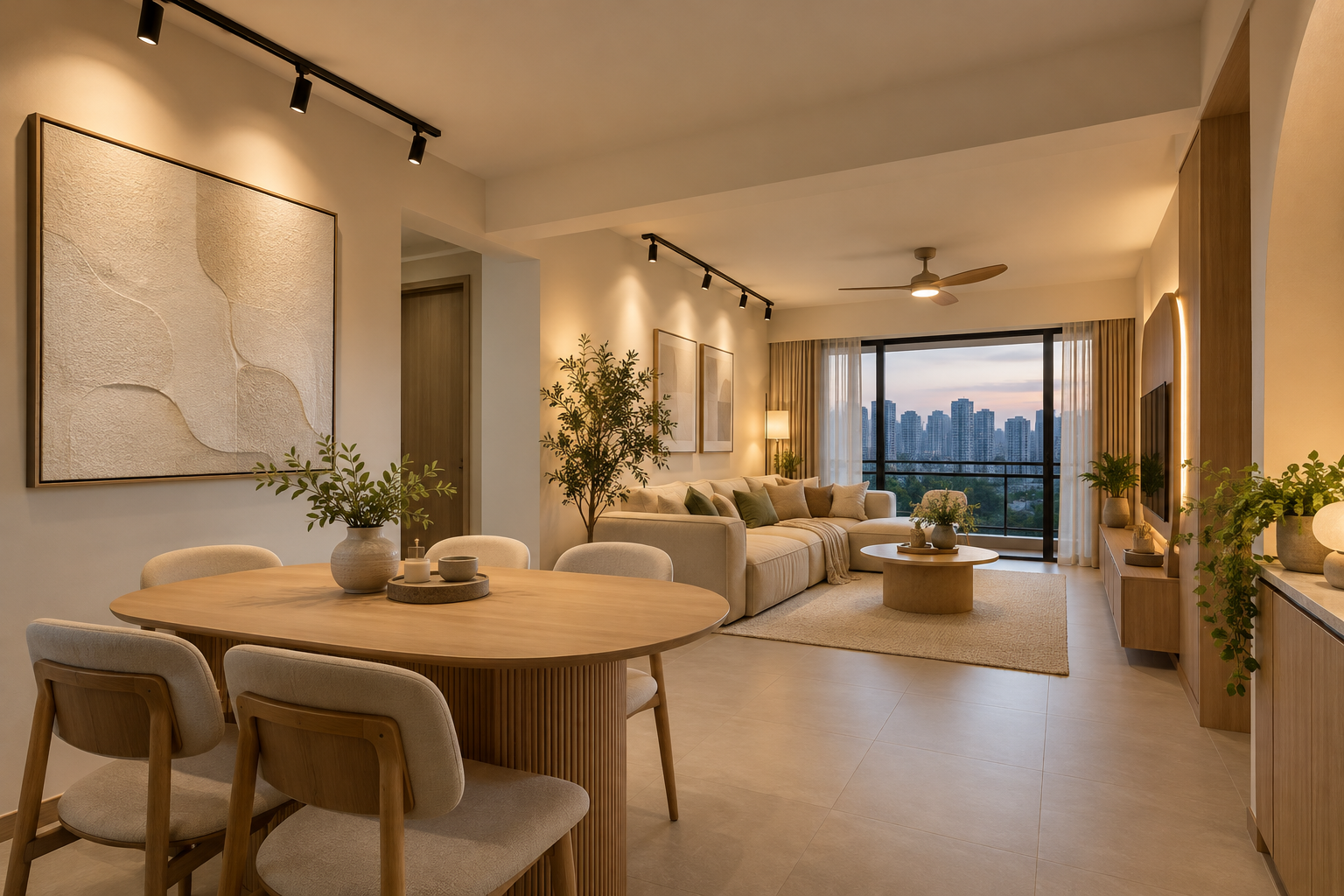
Track lighting is often chosen for its clean appearance and adjustable heads. In an HDB or BTO home, the more important question is where the light should fall and whether the arrangement remains comfortable from the sofa, dining chair or desk.
This guide helps Singapore homeowners compare track systems and prepare a lighting brief before purchasing fittings. It focuses on the lighting arrangement; a separate ceiling proposal may still be needed where construction or concealed services are involved.
1. Choose the activities before the track shape
Mark reading, dining, television viewing, working and circulation on the furniture plan. Identify which areas need light together and which should be controlled separately. Then consider the positions and aiming of the fittings.
A neat rectangle on the ceiling is not automatically a useful lighting plan. Ask the designer to explain the purpose of each head and how the proposal works when the furniture is occupied.
2. Surface track, recessed track or another fitting?
A surface-mounted arrangement and a recessed system have different construction and access implications. Compare the complete installed solution, including support, wiring, drivers or other components where applicable and the work needed at the ceiling.
Downlights, pendants and task lamps may solve some activities differently. RenoLinkUp’s track lights versus downlights guide provides a useful comparison prompt. You do not need one fixture type to perform every role in the home.
3. Understand what you are buying
Request the actual system reference, compatible heads, power components and control arrangement. If the system is described as magnetic, do not assume parts from another manufacturer will fit or function correctly. Have the supplier confirm compatibility and replacement availability.
Compare documented light output, beam options and colour characteristics for the selected products. A wattage alone is not a complete description of the lighting result. If dimming matters, have the proposed components and controls checked as a compatible system.
Ask about future changes
Clarify what a homeowner can adjust according to the supplier’s instructions and what needs professional attention. Ask how replacement heads or components are obtained, and whether a failed item can be changed without replacing the whole installation.
4. Check glare from the seats
Assess the lights from the positions where people spend time, not only while standing beneath them. A head aimed across the room can be uncomfortable in a seated sightline or reflected in a television or monitor.
Review the proposed aiming after installation with the relevant team. If a beam is intended to illuminate art or a wall, check the result on that actual surface. Glossy and textured finishes can behave differently in the same arrangement.
5. Coordinate with fans, curtains and cabinetry
Put the track on the same ceiling drawing as other equipment. Have any required separations, support and installation conditions assessed by the responsible installers. Do not assume the decorative plan resolves those details.
Also review tall cabinets, curtain stacking and opening doors. Keep component access practical. A system should be considered in the completed room, where furniture and fittings occupy real space.
6. Build useful switching scenes
Describe simple situations such as cleaning the room, watching television or eating dinner. Ask which fittings operate in each situation and where the controls are located. More switches are not necessarily better if the household cannot easily understand them.
In a shared living area, a separate reading light may be more useful than brightening every track head. Our living-room guide helps establish those activity zones.
7. Confirm the installation scope
Consult the applicable HDB electrical renovation guidance and have the actual installation carried out by the appropriate professionals. Confirm who supplies the products and who takes responsibility for installation and product issues.
- Track lengths, layout and mounting arrangement.
- Quantity and reference of each head.
- Required compatible components and controls.
- Wiring, ceiling work and making good.
- Testing, aiming and demonstration.
- Warranty, replacement arrangements and exclusions.
Frequently asked questions
Is track lighting enough for the whole room?
Assess the output, aiming and activities. A combination of light sources may serve the room better than making one system cover everything.
Can I add more heads later?
Ask the supplier about the selected system’s capacity, compatibility and installation conditions. Do not assume additions are unlimited.
Plan the lighting with the interior
Request a renovation discussion with Crown Interior Design with your floor plan, furniture and lighting references. Crown Interior Design can coordinate the visual direction with the wider home-planning brief.