
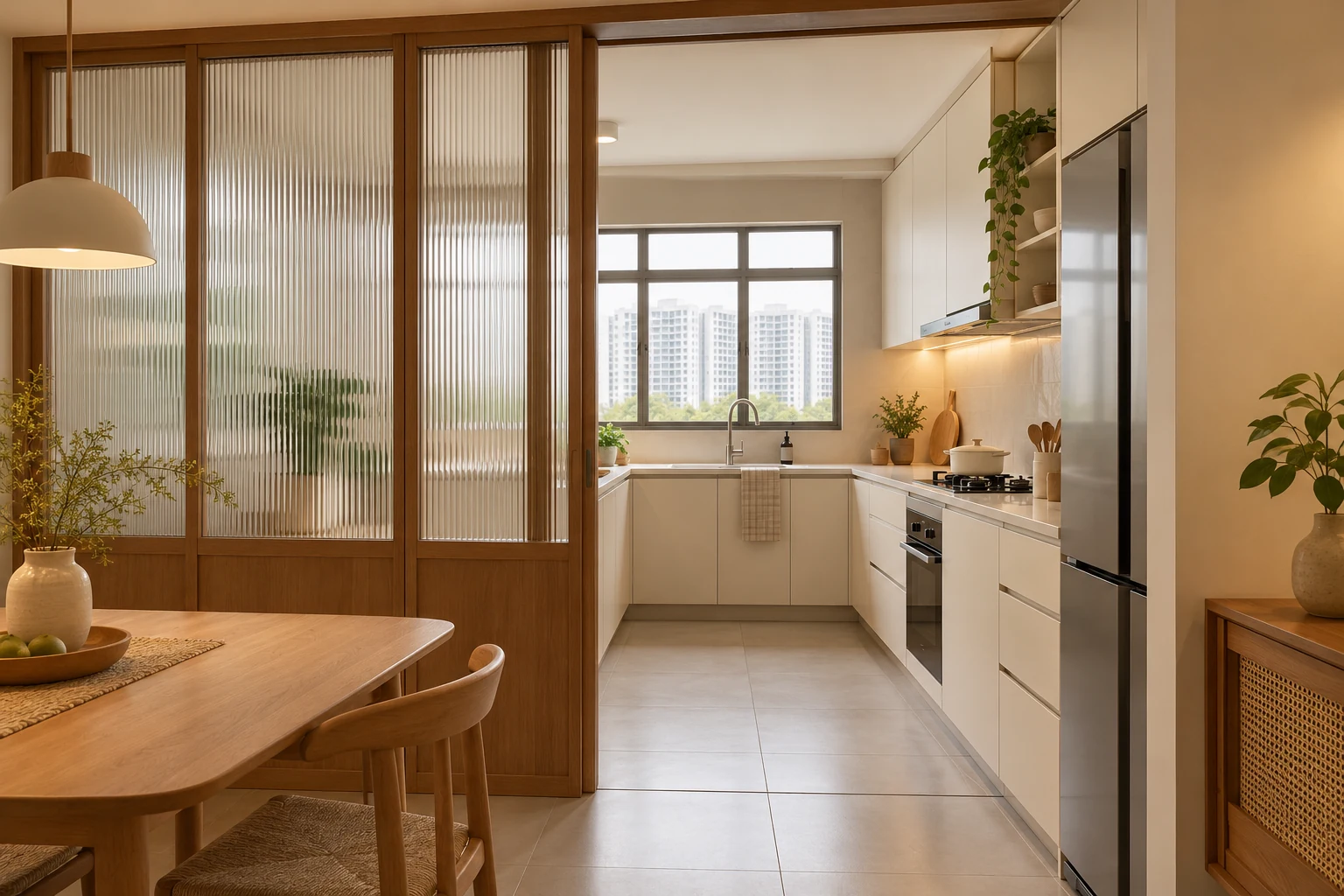
Reeded and frosted glass can both soften views between spaces, but they do not create the same appearance. The result also changes with light, distance and the position of the person on either side. Neither label should be treated as a universal privacy guarantee.
In a Singapore home, compare samples in the intended room relationship before selecting a kitchen screen, door or divider. Decorative texture and the appropriate glazing specification are separate parts of the decision.
1. Define what needs to be concealed
Decide whether the aim is to soften clutter, separate activities or provide stronger visual privacy. A screen that works for a kitchen view may be inappropriate for another room’s requirements. Identify the normal viewing distance and angles. Do not select a pattern solely from a close-up product photograph without considering what people can see through the whole panel.
2. Compare samples under realistic lighting
Look from both sides and test brighter light behind the glass. Review silhouettes and views at the distances that matter. A small sample can show texture but may not establish the effect of a full-height installation. Where privacy is important, ask the supplier for an appropriate representative demonstration rather than rely on a generic description.
3. Coordinate texture and frame proportions
Reeded texture introduces a visible rhythm, while frosted finishes can create a more uniform-looking surface. Compare each with the room’s cabinetry, walls and other patterns. Consider the size and number of frame divisions. A restrained panel arrangement may be more coherent than combining strong glass texture with several competing decorative features.
4. Check movement and the complete opening
For a door or sliding screen, test the opening, handles and adjacent furniture. Ask how the selected glass and frame work with the appropriate hardware. Do not assume every decorative pane can be substituted into any existing door. Have the relevant supplier specify a suitable assembly for the intended location and use.
5. Review cleaning and replacement
Ask which surface carries the texture or treatment, how it is cleaned and what care methods to avoid. Consider the location’s ordinary exposure and reach. Confirm how a damaged panel or moving component can be replaced. A large fixed pane can look simple while requiring a different maintenance plan from a small operable panel.
6. Approve the whole specification
Record the selected product, finish, glazing assembly, frame, hardware and relevant installation scope. Compare quotes for equivalent panel sizes and operation. At installation review, test the views and movement as agreed. If the actual privacy effect is critical, resolve it before fabrication rather than expecting a later decorative film to correct an unsuitable choice.
Compare the options
| Option | Useful when | Resolve first |
|---|---|---|
| Reeded texture | A directional visual pattern suits the room | Actual views and cleanability |
| Frosted finish | A more uniform diffusion is preferred | Representative privacy test |
| Different screen arrangement | The required privacy or opening is not met | Full assembly and room relationship |
A practical planning example
An illustrative household chooses reeded glass for a kitchen divider after viewing a close-up sample. Testing it with a bright light behind may change their view of what remains visible. Comparing an appropriate frosted sample or another screen arrangement before ordering avoids relying on the pattern name alone. This is not a completed Crown Interior Design project.
Frequently asked questions
Is frosted glass completely private?
Do not assume so. Check the selected product under relevant light, distance and viewing conditions.
Can textured glass go in any frame?
The supplier must confirm a suitable glazing, frame and hardware assembly for the intended use.
Which looks better in a small flat?
Compare the actual panel sizes, surrounding patterns and room relationship rather than applying a universal style rule.
Related planning: 7 Room Divider Decisions for Singapore HDB Homes · Kitchen Sliding Door Singapore: 8 Checks Before Ordering · Pocket Doors Singapore: 7 Checks Before Renovation.
For a separate reference, use RenoLinkUp’s interior design mock-up checklist.
Explore the related decision in Modern Oriental Interiors: 6 Singapore Home Choices.
Plan your project with Crown Interior Design
Send your floor plan, photographs, intended use and budget priorities. Explore Crown Interior Design’s services and residential projects, then request a tailored quotation. Confirm the scope and any specialist involvement for your actual premises.