
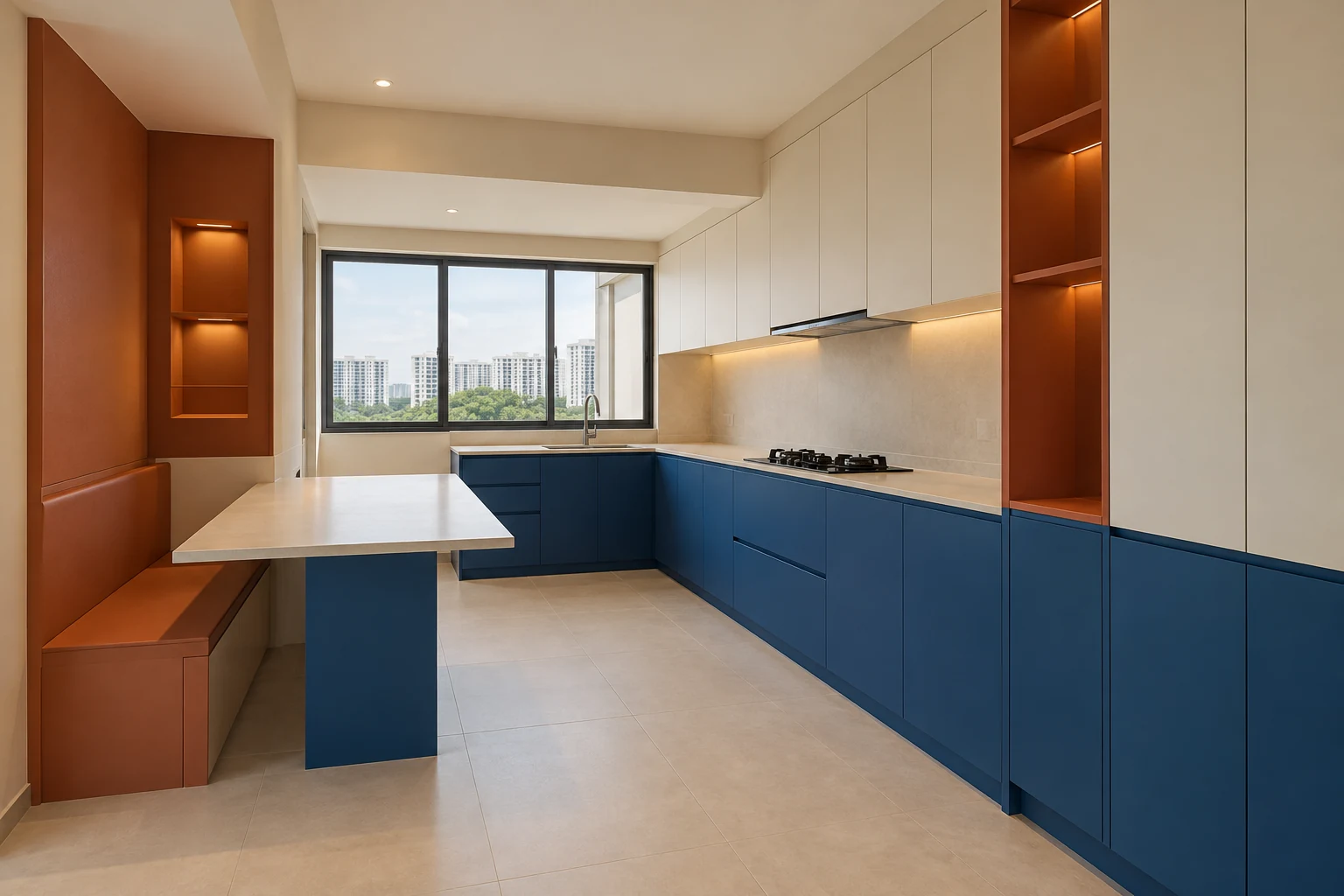
Colour-led contemporary can be a useful starting point for a Singapore home renovation, provided the reference becomes a clear fitted-furniture brief. This listicle translates the direction into decisions about materials, proportions, storage and lighting.
Use these eight decisions when discussing an HDB BTO, resale flat or condo proposal with Crown Interior Design. They are planning suggestions, not a fixed specification or a promise that the theme suits every property. Confirm the actual site conditions and quotation before approving work.
1. Choose the dominant colour role
Decide whether colour will organise a room, highlight one fitted function or provide a limited accent. A colour-led contemporary brief needs a clear hierarchy. Start with the largest cabinet area and work outward, rather than choosing several equally strong colours independently for adjacent zones.
2. Test saturation on a large surface
A small cobalt sample can look lively while a full wall feels much stronger. View a larger mock-up or sample arrangement in the actual room where feasible. Compare a quieter version before approval, particularly for fixed joinery that will be more involved to replace than a painted wall.
3. Use neutral areas deliberately
Cream upper cabinets or a plain surrounding wall can give a coloured lower run room to breathe. The neutral is part of the design, not unused space that must be filled. Review the complete elevation so that the colour proportion remains balanced across tall units, counters and open niches.
4. Connect colours through undertones
Test the coloured fronts beside the floor, worktop and metal details. A terracotta niche and blue cabinet can work as a deliberate contrast, but the actual shades matter. Keep the approved samples together so that later substitutions do not introduce an unrelated undertone into the fitted scheme.
5. Check lighting colour changes
View the palette in daylight and under the intended evening fittings. Strong colours can shift noticeably between conditions. Confirm the lighting specification before finalising the cabinet colour, and keep task illumination adequate rather than lowering the room brightness simply to make the chosen palette feel less intense.
6. Plan replacement and continuity
Ask whether a damaged panel can be remade in the specified colour and finish, and retain the product information. Avoid unnecessary reliance on several uncommon colours across permanent joinery. A controlled accent area can provide personality while making future repair or a change of preference easier to manage.
7. Keep function visible
Colour zoning can help distinguish storage areas, but it should not substitute for a workable internal layout. Measure the contents and check door movement first. If a colour break requires an awkward cabinet division, reconsider the graphic composition rather than sacrificing useful storage to an elevation pattern.
8. Approve the whole palette together
Review every fixed finish on one board and mark its location on the drawings. Include the less prominent end panels and fillers, which can disrupt a strong colour composition if overlooked. Ask for separate pricing of special colours or finishing methods before deciding how extensively to use them.
Compare the options
| Option | Useful when | Resolve first |
|---|---|---|
| A restrained interpretation | You want the theme with fewer special details | Choose the main palette and one signature feature |
| A more detailed interpretation | The additional profiles or finishes matter to you | Itemise fabrication, lighting and maintenance access |
| An adapted interpretation | Existing flooring or cabinetry will remain | Test new samples against retained elements |
A practical planning example
Consider owners considering blue lower cabinetry with a terracotta display recess. This is an illustrative planning scenario, not a completed Crown Interior Design project. Make the blue the lead accent and test whether the second colour adds enough value to keep. Approve the combined samples and the exact location of each finish, including fillers and end panels.
Frequently asked questions
Does colour-led contemporary require a complete renovation?
Not necessarily. Review which existing surfaces and fitted units can remain in sound, usable condition. An adapted palette and a limited fitted feature may be enough, but compatibility, access and the actual scope should be checked before assuming a partial update will achieve the reference.
How should I compare renovation quotations for this theme?
Provide the same floor plan, cabinet requirements and approved material direction to each firm. Compare construction, fittings, finishes and installation inclusions. Ask for special profiles or surface treatments to be itemised; a style label on a package does not define what will be delivered.
What should I bring to a design consultation?
Bring your floor plan, current photographs, selected references and a list of storage and maintenance priorities. Mark what you like in each image and identify what must remain. This gives the designer a more useful starting point than asking for an exact copy of a photographed room.
Related planning: Contemporary Interior Design: 7 Singapore Planning Choices · Eclectic Interior Design: 7 Singapore Home Choices · Renovation Material Selection: 6 Sample Approval Checks.
Explore the related decision in Bohemian vs Eclectic: 8 Home Design Decisions.
Plan your project with Crown Interior Design
Send your floor plan, photographs, intended use and budget priorities. Explore Crown Interior Design’s services and residential projects, then request a tailored quotation. Confirm the scope and any specialist involvement for your actual premises.
For wider planning, explore interior design in Singapore with Crown Interior Design.