
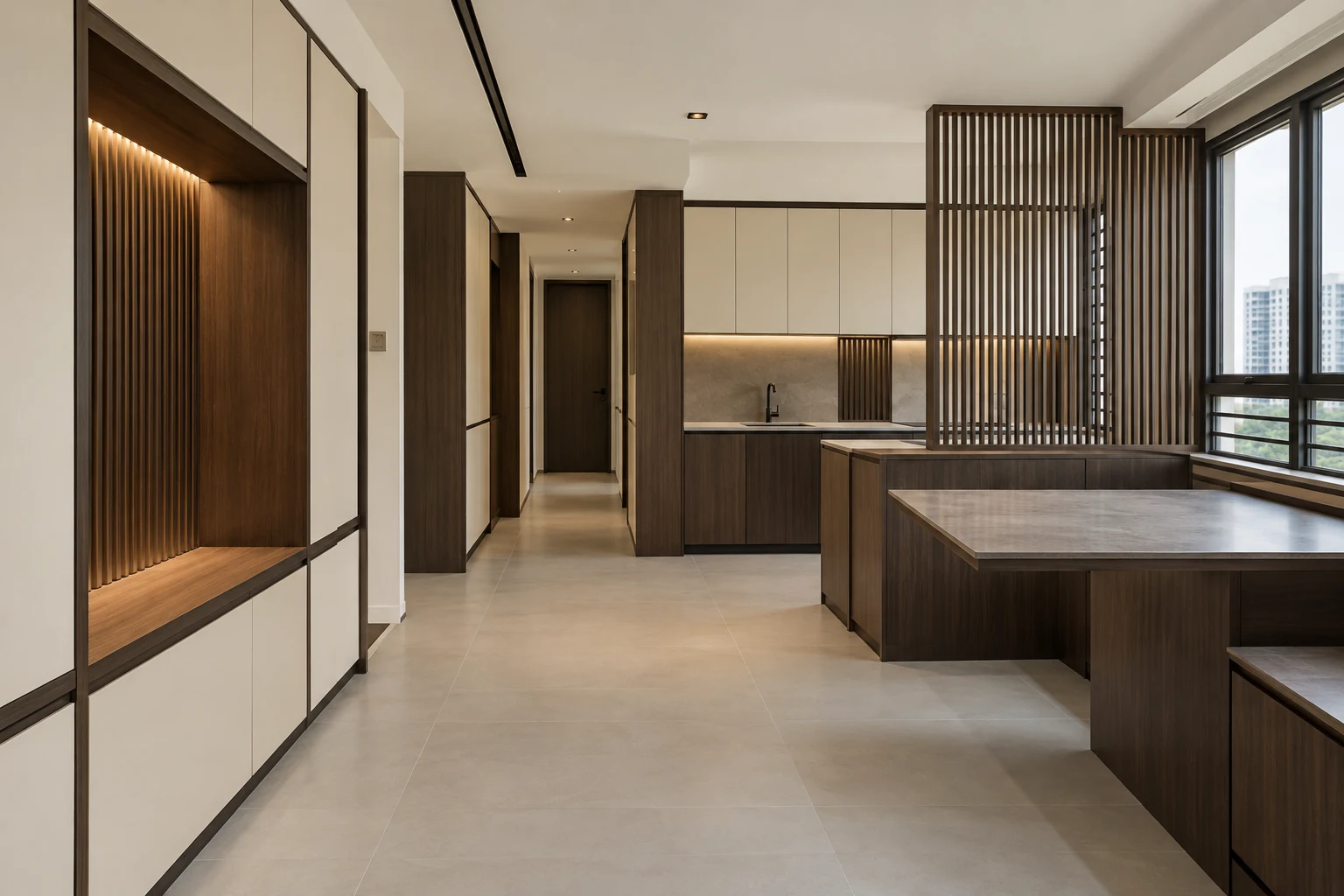
Choosing between Modern colonial and modern Oriental? The useful question is what changes in your actual renovation brief. This comparison focuses on fitted cabinetry, surface choices and daily use, rather than treating either style as a fixed package.
Use these eight decisions when discussing an HDB BTO, resale flat or condo proposal with Crown Interior Design. They are planning suggestions, not a fixed specification or a promise that the theme suits every property. Confirm the actual site conditions and quotation before approving work.
1. Identify the references you mean
Modern colonial and modern Oriental are broad labels that different designers interpret differently. Select specific reference images and explain the features you like: framed fronts, lattice, dark timber or restrained symmetry. Avoid treating either label as a single authentic cultural formula that every Singapore home should reproduce.
2. Compare framed and screened elements
A colonial-inspired option might emphasise framed cabinet doors; an Oriental-inspired option might use a restrained lattice screen. Both need practical dimensions and cleaning access. Check that the decorative framing does not reduce usable storage or interfere with switches, sockets and the movement around the fitted unit.
3. Balance dark timber with the room
Deep timber can anchor either scheme, but its extent should reflect the actual light and ceiling height. Compare one dark fitted wall against several dark walls before committing. Keep a full material board so that the floor, cabinet tone and lighter wall surfaces are reviewed together.
4. Use symmetry selectively
Symmetry can make a fitted elevation feel ordered, but it should not force false doors or unusable compartments. Start with the required storage and adjust the visual balance around it. A slightly asymmetric solution can be more practical when windows, structural elements or household equipment do not sit centrally.
5. Choose a meaningful accent
A bronze pull, a geometric inset or a subtle green panel can provide enough emphasis. Avoid layering several unrelated motifs to prove the theme. Ask the designer to explain how the accent relates to the main cabinet proportion, and remove details that do not contribute to that composition.
6. Assess openwork maintenance
Fine lattice and deep panel moulding can collect dust and require careful finishing. Handle a sample before approving it over a large area. Where easy wiping matters more than texture, a simpler framed front may be the more appropriate interpretation without abandoning the overall design direction.
7. Compare fabrication scope
Request separate pricing for custom lattice, framed fronts, special stains and metal work. A standard panel with a well-chosen proportion may achieve the brief more efficiently than extensive bespoke ornament. Compare the same internal fittings and storage capacity so that decorative additions do not hide a reduction in practical scope.
8. Keep authorship and claims accurate
Use references as inspiration and credit external projects when discussing them. Do not imply that another firm’s completed home is a Crown Interior Design project. For your own brief, approve the actual drawings and samples rather than assuming a historical style label establishes craftsmanship or award recognition.
Compare the options
| Option | Useful when | Resolve first |
|---|---|---|
| Modern colonial | You prefer the first material and form direction described above | Approve its sample board and fitted elevation |
| modern Oriental | The alternative palette and detail better suit your room | Compare the same storage and functional scope |
| A restrained combination | You like selected details from both | Choose one lead language and resolve the junctions |
A practical planning example
Consider a family comparing a dark framed cabinet wall with a lighter lattice-accented alternative. This is an illustrative planning scenario, not a completed Crown Interior Design project. Measure the contents and allow access to existing switches first. Review one representative framed or screened section at full scale, then limit the decorative language to the areas where it fits comfortably.
Frequently asked questions
Is Modern colonial or modern Oriental cheaper?
Neither label determines the price. Compare cabinet quantities, construction, fittings, finishes, lighting and installation on the same scope. Custom profiles or matched surfaces should be identified separately so that the reason for a difference is visible.
Can both directions work in a Singapore BTO flat?
Either can inform a BTO brief, but the actual layout, daylight, storage needs and permitted works must be reviewed. Keep the comparison tied to your floor plan. Do not assume that a reference image from another home proves the same layout or alterations are suitable.
Can I combine these themes?
Yes, if the combination has a clear lead palette and a small number of secondary details. Ask for a coordinated elevation and sample board showing the junctions. If the references demand conflicting profiles or too many finishes, simplify the fixed elements first.
Related planning: Modern Colonial Interiors: 7 Singapore Planning Choices · Modern Oriental Interiors: 6 Singapore Home Choices · Renovation Material Selection: 6 Sample Approval Checks.
Explore the related decision in Modern Classic Interiors: 8 Singapore Home Decisions.
Plan your project with Crown Interior Design
Send your floor plan, photographs, intended use and budget priorities. Explore Crown Interior Design’s services and residential projects, then request a tailored quotation. Confirm the scope and any specialist involvement for your actual premises.
For wider planning, explore interior design in Singapore with Crown Interior Design.