
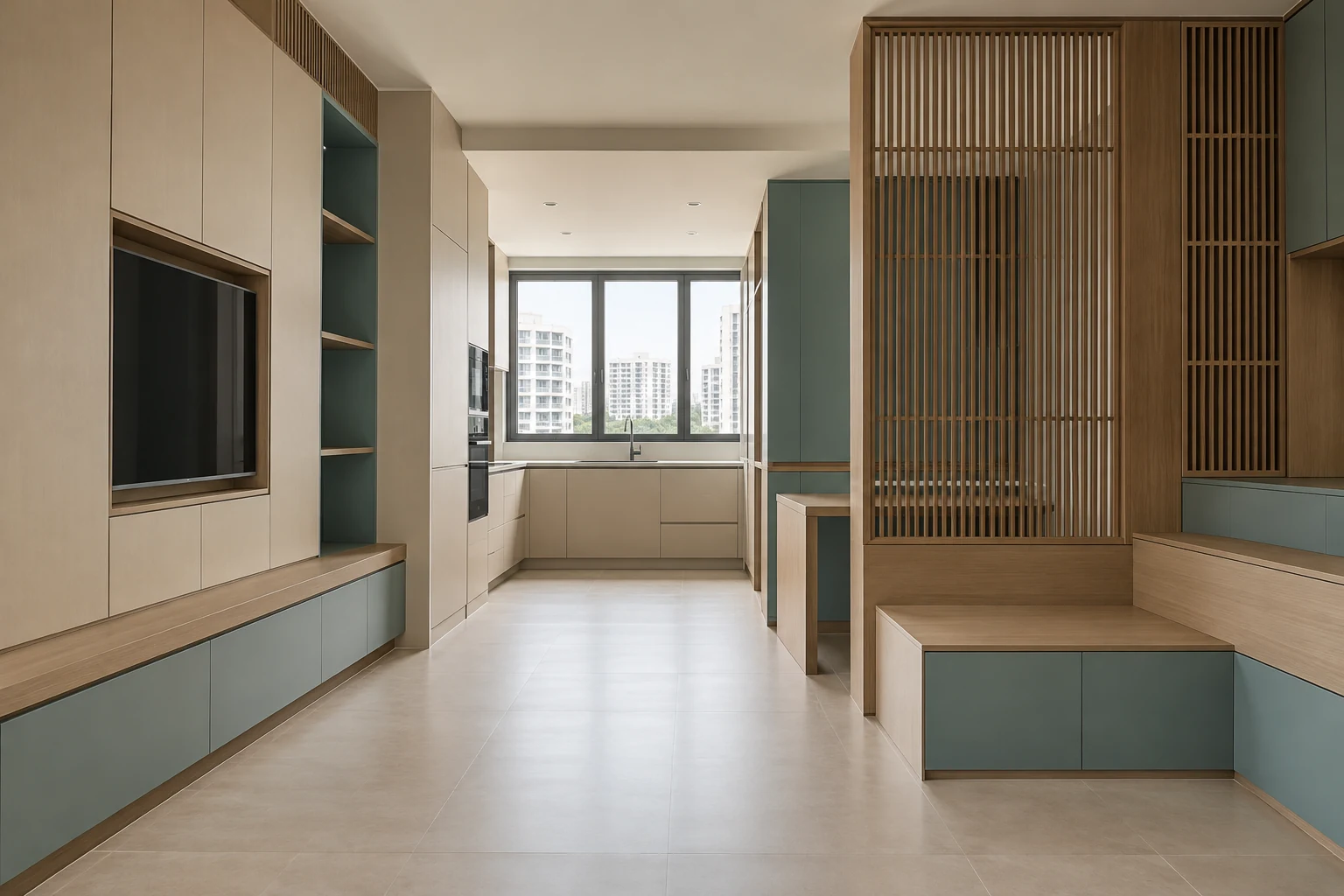
Choosing between Coastal and tropical? The useful question is what changes in your actual renovation brief. This comparison focuses on fitted cabinetry, surface choices and daily use, rather than treating either style as a fixed package.
Use these eight decisions when discussing an HDB BTO, resale flat or condo proposal with Crown Interior Design. They are planning suggestions, not a fixed specification or a promise that the theme suits every property. Confirm the actual site conditions and quotation before approving work.
1. Define lightness or depth
A coastal brief can start with sand tones and a pale, open-looking palette. A tropical brief might use deeper timber and green accents. These are adaptable directions rather than fixed categories. Compare both against the flat’s actual daylight and avoid assuming a theme will make a dark room naturally bright.
2. Choose an abstract reference
Sea-glass colour, woven texture or a screened cabinet can communicate the theme without literal shells or leaf motifs. Pick one reference and develop it through fitted details. A compact apartment usually benefits from a consistent language more than multiple themed decorations competing for attention.
3. Check screened storage function
Slatted or woven-look fronts can add texture, but ask about dust access, privacy and the supporting construction. Do not assume they provide sufficient ventilation for appliances. Compare the coastal and tropical versions with the same contents list and verify any equipment requirements separately before approving the front design.
4. Compare timber tones
Pale timber may strengthen coastal lightness; a richer tone can support tropical depth. View each with the floor and worktop. If the existing floor already has pronounced grain, a quieter cabinet finish may work better than introducing another competing pattern simply to reinforce the chosen theme.
5. Set the blue or green boundary
A muted blue niche or green lower cabinet can create a clear accent. Keep the extent deliberate and test the colour under evening lighting. Place harder-to-replace built-ins in tones you are comfortable maintaining, rather than choosing a saturated colour solely because it looks attractive in one photograph.
6. Plan cleaning at textured details
A tropical screen or coastal woven-look panel needs a cleaning method compatible with its material. Ask for an accessible sample and maintenance instructions. Where cooking residue is likely, compare a smooth equivalent. The visual effect can often be retained without placing intricate textures in the hardest-working location.
7. Keep daylight and services clear
Do not cover windows or service access with themed joinery before checking the actual constraints. A shallow fitted feature may achieve the desired atmosphere with less obstruction. Review window operation, air-conditioning interfaces and access to existing services on site before extending the cabinet composition.
8. Prioritise a coherent material schedule
Choose a base neutral, one timber family and a restrained accent, then show them together on the drawings. Coastal or tropical can be the description of that composition rather than a shopping list. Request separate prices for textured fronts and screens so that optional details remain easy to adjust.
Compare the options
| Option | Useful when | Resolve first |
|---|---|---|
| Coastal | You prefer the first material and form direction described above | Approve its sample board and fitted elevation |
| tropical | The alternative palette and detail better suit your room | Compare the same storage and functional scope |
| A restrained combination | You like selected details from both | Choose one lead language and resolve the junctions |
A practical planning example
Consider owners choosing between sea-glass blue cabinetry and deeper green screened storage. This is an illustrative planning scenario, not a completed Crown Interior Design project. Test both beside the existing floor. Keep the busy preparation area smooth, and place any textured screen where its contents and cleaning access make sense rather than extending it across all cabinets.
Frequently asked questions
Is Coastal or tropical cheaper?
Neither label determines the price. Compare cabinet quantities, construction, fittings, finishes, lighting and installation on the same scope. Custom profiles or matched surfaces should be identified separately so that the reason for a difference is visible.
Can both directions work in a Singapore BTO flat?
Either can inform a BTO brief, but the actual layout, daylight, storage needs and permitted works must be reviewed. Keep the comparison tied to your floor plan. Do not assume that a reference image from another home proves the same layout or alterations are suitable.
Can I combine these themes?
Yes, if the combination has a clear lead palette and a small number of secondary details. Ask for a coordinated elevation and sample board showing the junctions. If the references demand conflicting profiles or too many finishes, simplify the fixed elements first.
Related planning: Coastal Interior Design: 7 Singapore Home Decisions · Tropical Interior Design: 7 Singapore Home Decisions · Renovation Material Selection: 6 Sample Approval Checks.
Explore the related decision in Mediterranean-Inspired Homes: 8 Design Decisions.
Plan your project with Crown Interior Design
Send your floor plan, photographs, intended use and budget priorities. Explore Crown Interior Design’s services and residential projects, then request a tailored quotation. Confirm the scope and any specialist involvement for your actual premises.
For wider planning, explore interior design in Singapore with Crown Interior Design.