
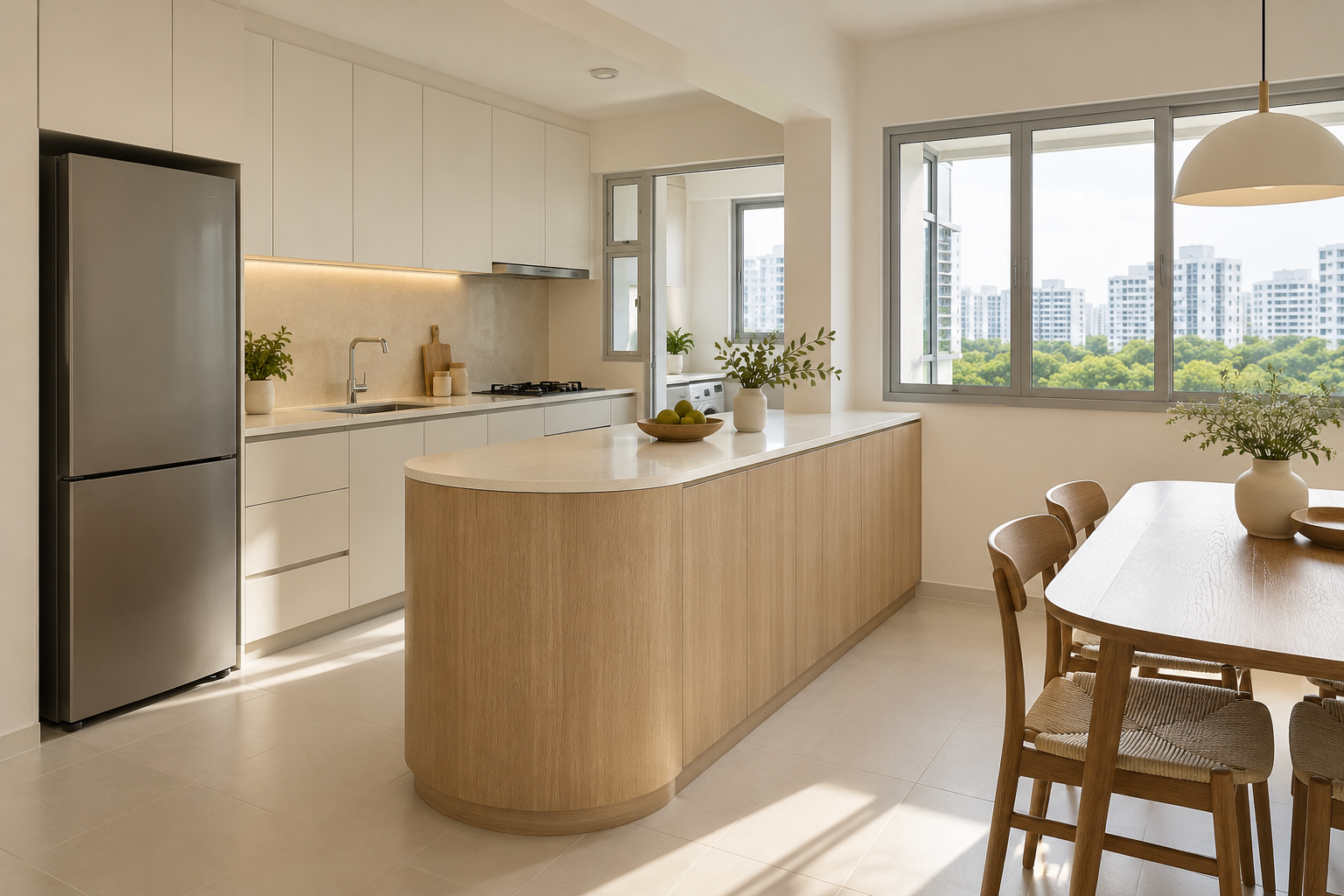
Curved carpentry can soften an interior and change how a cabinet meets a walking route, but the curve needs to be defined precisely. A rounded external end, a curved door and an arched opening are different design and fabrication decisions. They should not be priced or approved as one vague request for a soft look.
For a Singapore HDB, BTO or condo renovation, compare the curved proposal with a straight alternative on your actual plan. This guide focuses on joinery geometry and specification. It does not assume that a decorative arch is structural work or that a rounded detail automatically makes a room safe for every user.
1. Name the part that needs to curve
Identify whether you want an external cabinet end, a countertop edge, an open shelf or a working door to change shape. Mark it on the plan and elevation. A reference photograph can conceal whether the curved part is usable storage or a solid decorative end. Ask the designer to explain the exact proposal. This avoids approving an attractive outline only to discover later that the internal capacity or operation differs from what you expected.
2. Check the footprint at the walking route
Draw the outermost edge and compare it with a straight option. A softened corner may improve the experience of passing a cabinet, but an enlarged curved form can also occupy more floor area. Review chairs, doors and appliances in use beside it. Do not judge circulation from an empty rendering. The useful question is whether the actual geometry gives the household a better daily route for the space it consumes.
3. Inspect the internal storage consequence
Ask for an internal plan showing shelves, drawers and access. A curve can leave an awkward compartment or turn part of the cabinet into a non-storage zone. That may be acceptable when the visual benefit is deliberate, but it should be understood before ordering. Compare the usable arrangement, not just the external length. If storage is the priority, a rounded end combined with straightforward internal compartments may be worth discussing with the fabricator.
4. Confirm the finish and fabrication method
The chosen material and surface need to suit the actual curve. Ask the fabricator to explain how the assembly, seams and edges will be made. Do not assume every laminate, veneer or worktop product bends or joins in the same way. Review a relevant sample or mock-up where a critical detail is difficult to understand from drawings. Keep the approved material and geometry recorded so the intended result is not left to interpretation during installation.
5. Resolve the junction with straight elements
Check where the curve meets a door, drawer front, skirting, wall or countertop. A smooth outer face can still have an awkward end detail. Review alignment and how adjacent parts operate. Where a worktop continues over the curved cabinet, coordinate the fabricator’s requirements and the actual edge profile. The cabinetmaker and surface supplier should not work from incompatible assumptions about the same junction.
6. Keep curves selective within the room
A single rounded cabinet end may be enough to create the intended softness. Multiple arches, curved shelves and shaped ceilings can compete in a compact flat. Compare the full room rather than approving each feature separately. Give plain surfaces a role in the composition. If you are evaluating award-winning interiors as references, ask what the geometry achieves in that project and whether the same benefit exists in your plan.
7. Price and inspect the defined detail
Request the actual dimensions, finish, internal arrangement, hardware and installation scope. Compare it with the straight alternative rather than an unrelated cabinet package. Agree how a critical sample or mock-up will be reviewed. At handover, inspect the operation and junctions alongside the visual finish. Crown Interior Design can discuss a proportionate use of curves within the wider renovation, with feasibility and fabrication responsibilities agreed before production.
Compare the options before committing
| Option or decision | Useful when | Check before approval |
|---|---|---|
| Rounded external end | A cabinet corner needs a softer transition | Actual footprint and internal capacity |
| Curved working door | The design requires a shaped operating element | Hardware, fabrication and access |
| Straight alternative | Storage or budget takes priority | Comparable dimensions and complete specification |
A worked planning example
An illustrative BTO owner wants a curved peninsula end beside the dining route. An internal drawing shows that the proposed curve creates little usable storage. The owner can compare a smaller rounded end, a straight cabinet with a considered edge or the original full curve. Making that choice before fabrication turns a vague preference into an understood trade-off. It is not a construction specification or a price estimate.
What to bring to the design discussion
- Annotated reference showing exactly what should curve
- Measured plan with doors and furniture in use
- Internal storage and junction drawings
- Material samples, fabrication detail and comparable scope
Frequently asked questions
Does curved carpentry always cost more?
Ask for a like-for-like comparison. Geometry, material, fabrication and internal arrangement affect the actual quotation.
Will the curve provide extra storage?
Not necessarily. Review the internal plan and access before judging capacity from the outer shape.
Are all curves suitable for laminate or veneer?
No blanket assumption is useful. The fabricator should confirm the exact product and proposed method.
Plan your project with Crown Interior Design
Send your floor plan, current photographs, intended use, timing and budget priorities. Explore Crown Interior Design’s design and renovation services and residential projects, then request a tailored quotation. The proposed scope and any specialist involvement should be confirmed for your actual premises.
Continue planning: Custom Carpentry Singapore: Built-Ins & Quotation Guide · 7 Kitchen Island Decisions for Singapore HDB Homes · 8 Kitchen Countertop Checks Before You Order in Singapore.
For a separate practical checklist, see RenoLinkUp’s interior design mock-up checklist.