
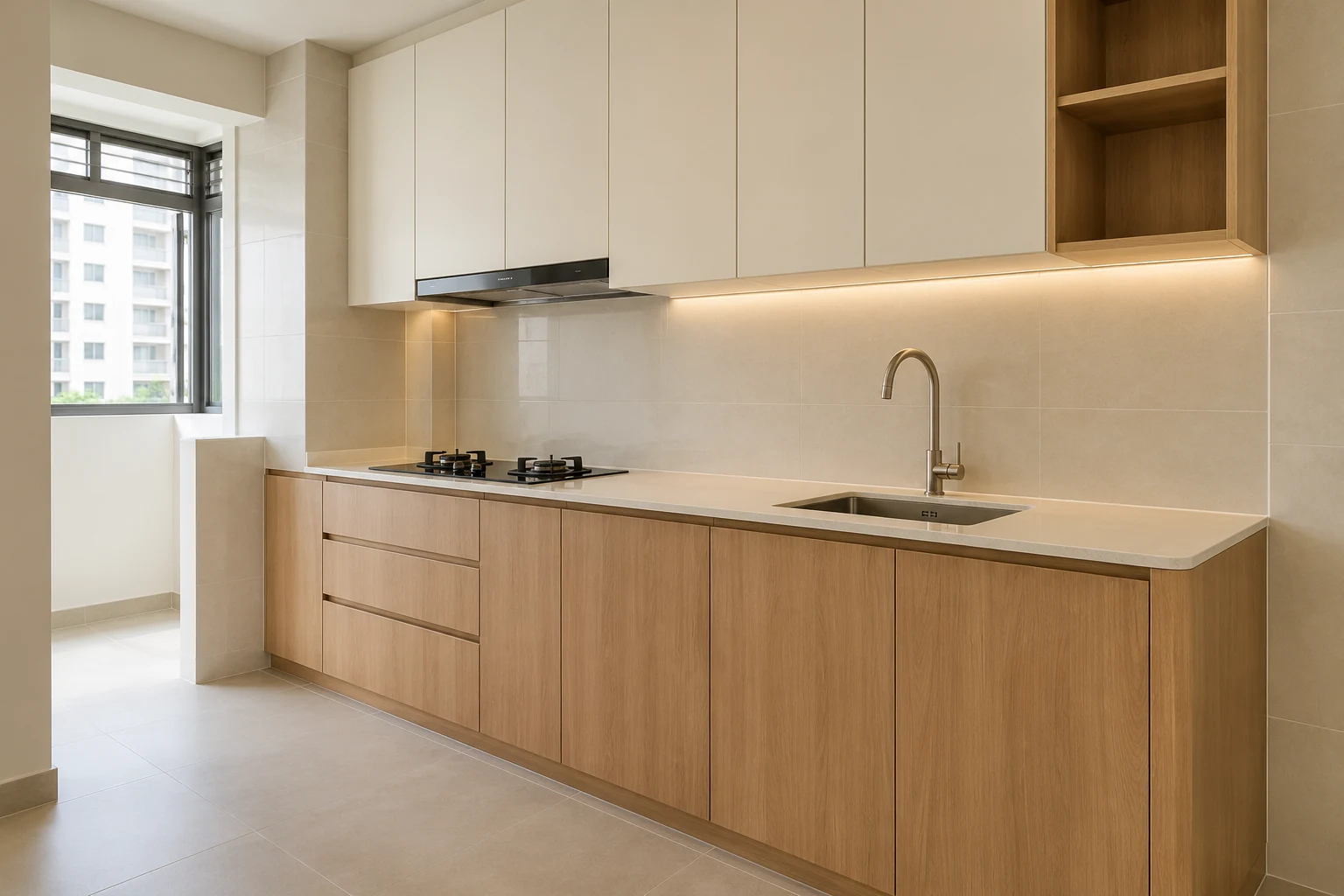
Kitchen cabinet materials are easier to compare when the cabinet body and visible door finish are described separately. A wood-look door does not tell you what supports it, and a named board does not define the complete installed kitchen.
These eight checks help Singapore homeowners turn material preferences into a useful quotation brief. They do not rank every product or claim that one material is suitable for all locations and cooking routines.
1. Separate the cabinet body from its surface
Ask which material forms the cabinet body and which product covers the visible front. Record backing, internal surfaces and exposed sides too. A single label such as acrylic or laminate may describe only part of the assembly.
Compare complete constructions. Two kitchens with similar photographs can use different substrates, internal finishes and edge treatments, so appearance alone is a weak basis for judging the specification.
2. Identify the exact proposed products
Request product names and relevant documentation where available. Marketing descriptions such as premium or moisture resistant need a defined basis. Ask what the selected product is intended for and which care instructions apply.
If alternatives are offered, record the differences rather than assuming they are equivalent. The agreed quotation should identify the actual assembly, not leave the principal material choice to an undocumented later substitution.
3. Match the assembly to its location
Discuss the sink area, cooking zone and other relevant exposures with the responsible designer and installer. Have existing damage or moisture concerns assessed before new cabinetry is installed.
Do not assume a more resistant surface solves an unresolved leak or makes the entire cabinet waterproof. The product, construction and surrounding conditions need to work together under the proposed installation.
4. Review edges and visible junctions
Ask how the selected finish meets edges, corners and adjoining units. Look at a representative door or completed sample where possible. A small flat swatch does not show the assembled result.
Confirm which sides remain visible when doors are open and how exposed end panels are finished. These details can explain a price difference between apparently similar material proposals.
5. Coordinate hardware with door construction
Have the fabricator select appropriate hinges and other fittings for the actual door size, weight and assembly. Do not choose a front independently of the hardware and fixing requirements that support it.
Record the selected fittings so the quotation describes more than a brand or a promise of soft closing. A material decision should preserve reliable operation as well as the intended appearance.
6. View samples in the complete palette
Place door, worktop and floor references together under relevant lighting. Large areas can look different from small samples, especially with reflective finishes or pronounced grain.
Use a restrained palette where the room is compact. Ask whether a decorative profile changes fabrication, cleaning or usable openings. The goal is a coordinated kitchen rather than adding a different feature to every surface.
7. Compare installed scopes and maintenance
Include internal fittings, worktop interfaces, delivery and installation in the comparison. A material-only figure is not the cost of a completed cabinet. Identify removal and making good where existing units are replaced.
Ask what can be adjusted, repaired or replaced later and who provides relevant follow-up. Avoid a universal lifespan claim when the actual product, use and maintenance conditions have not been established.
8. Approve a written material schedule
Keep the selected products, construction, finish references and hardware with the final drawings. Confirm the treatment of any unresolved choices before fabrication. If a substitution is proposed, review its consequences first.
At handover, compare the installed scope with that schedule and collect care guidance. A clear record makes future maintenance and questions more straightforward than relying on the colour name alone.
Compare the options
| Option | Useful when | Resolve first |
|---|---|---|
| Surface-led selection | Appearance is the initial priority | Identify the supporting construction |
| Location-led selection | Exposure or use needs attention | Product suitability and installation |
| Complete specification comparison | Two quotations look similar | Bodies, surfaces, edges and fittings |
A practical planning example
Illustrative example: two proposals describe cream cabinet fronts but specify different internal finishes and fittings. The homeowner requests a shared material schedule and reviews an assembled door sample. The comparison then addresses the whole cabinet rather than a surface label. No universal durability ranking, price or saving is implied.
Frequently asked questions
Does acrylic describe the whole cabinet?
Not necessarily. Ask which part of the assembly the term describes and what the supporting construction is.
Is a moisture-resistant label enough?
No. Confirm the actual product, intended use and surrounding condition with the responsible parties.
What belongs in a material schedule?
Record cabinet construction, internal and external finishes, edging, visible panels, fittings and relevant product references.
Related planning: Kitchen Cabinet Design Singapore: Layout & Storage Guide · Plywood vs MDF: 6 Singapore Carpentry Specification Checks · Laminate vs Veneer: 7 Singapore Carpentry Decisions · Aluminium Kitchen Cabinets: 7 Singapore Buying Checks.
References
Explore the related decision in Acrylic Kitchen Cabinets: 8 Singapore Buying Checks.
Plan your project with Crown Interior Design
Send your floor plan, photographs, intended use and budget priorities. Explore Crown Interior Design’s services and residential projects, then request a tailored quotation. Confirm the scope and any specialist involvement for your actual premises.
For wider planning, explore interior design in Singapore with Crown Interior Design.