
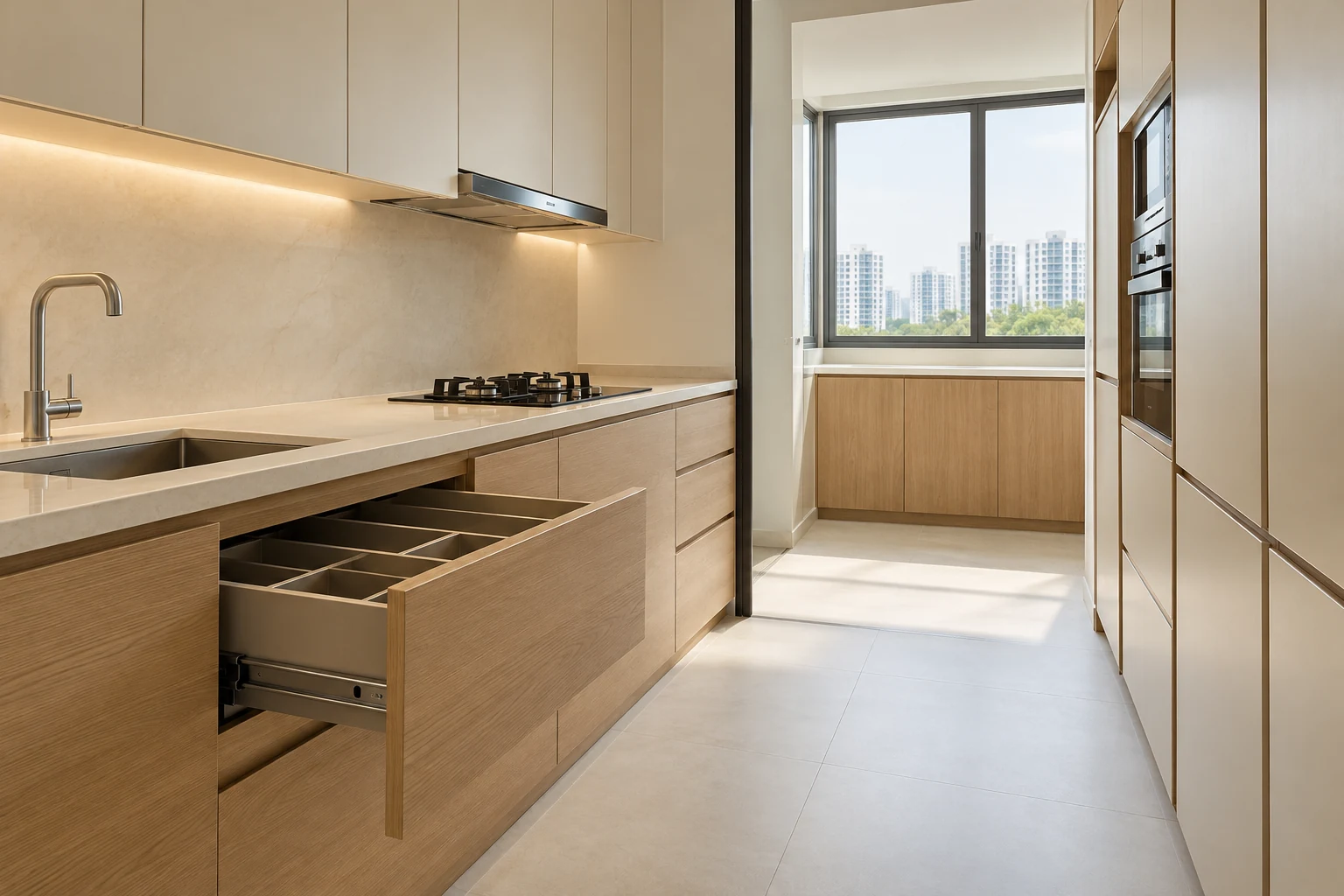
A kitchen drawer should be specified around what it holds and how it is reached. Soft closing is one feature, but it does not describe the runner’s length, intended application or suitability for the completed drawer.
These eight buying checks complement the choice between drawers and cupboards. They help you prepare questions for the fabricator without substituting for technical selection or installation guidance.
1. List the intended contents
Identify cookware, crockery, food or smaller utensils intended for each drawer. Discuss heavier items with the fabricator and keep the proposed contents realistic.
Do not assume a large-looking drawer can hold any load. The runner, drawer construction and installation need to be assessed as one assembly for the intended use.
2. Request the actual runner reference
Ask for the product or system included, not only a general description such as heavy duty. Manufacturer ranges can contain different options and applications.
For example, Blum’s Singapore MOVENTO information lists specific range options. Those details illustrate why a brand name alone is insufficient; they should not be transferred to another product or treated as a universal rating for every drawer.
3. Check how much access is provided
Review how the selected drawer opens and whether the back section is convenient to reach. Compare this against the actual contents rather than assuming the same opening behaviour in every system.
Keep nearby doors and passageways on the plan. Useful extension should improve access without creating an unresolved conflict in a narrow kitchen.
4. Coordinate the internal arrangement
Show dividers, trays or other selected components with the runner and drawer dimensions. Check usable space after the assembly is accounted for.
An accessory shown in a reference may not fit the proposed drawer. Ask the fabricator to confirm compatibility before ordering separate organisers or approving fabrication around an assumed internal width.
5. Review opening and closing together
Compare handles or push-opening arrangements alongside the selected closing feature. Test a representative system where possible and consider how it will be used during normal cooking.
Do not assume every opening technology combines with every runner or front. Have the responsible supplier confirm the actual arrangement rather than adding features independently.
6. Have installation suitability confirmed
Ask the fabricator to follow the relevant product guidance for the drawer and cabinet construction. Technical dimensions, fixing and loading should be confirmed by the responsible party.
The buying decision should require a suitable documented system, not a homeowner-designed workaround. Avoid approving a runner substitution solely because it looks similar in a photograph.
7. Compare the complete drawer scope
Include the drawer body, front, runner, selected internals and installation in the quotation comparison. A hardware-only price does not establish the cost of a finished drawer bank.
If you simplify the design, identify which drawer or accessory changes and what function is lost. This keeps the budget discussion connected to useful access rather than only reducing a line total.
8. Keep maintenance and handover information
Have the team demonstrate normal drawer operation and explain the relevant care or adjustment arrangements. Record issues with alignment or access through the agreed follow-up process.
Retain product references so later replacement can be assessed accurately. Do not infer that a different runner is interchangeable without checking the actual cabinet and drawer assembly.
Compare the options
| Option | Useful when | Resolve first |
|---|---|---|
| Basic storage drawer | The contents and access needs are modest | A suitable specified assembly |
| Higher-demand application | The intended contents need assessment | Product guidance and drawer construction |
| Special opening system | The user wants another operating method | Confirmed compatibility |
A practical planning example
Illustrative example: a homeowner plans deep drawers for cookware. The fabricator reviews the intended contents, drawer construction and selected runner range, then confirms the internals before fabrication. The homeowner compares the whole drawer specification across quotations. No general load rating or recommended runner is implied for another kitchen.
Frequently asked questions
Does soft close mean heavy duty?
No. Confirm the actual product and its suitability for the intended drawer.
Can I buy organisers first?
Confirm usable internal dimensions and compatibility with the fabricator before purchasing.
What should the quote identify?
The runner reference, drawer construction, front, selected internals and installation scope.
Related planning: Kitchen Drawers vs Cupboards: 6 Storage Decisions · Kitchen Pantry Cabinets: 6 Singapore Planning Checks · Pull-Out Kitchen Bins: 7 Singapore Carpentry Checks · Carpentry Quotes: 8 Per-Foot-Run Checks in Singapore.
References
Explore the related decision in Pull-Out Pantry Cabinets: 8 Singapore Buying Checks.
Plan your project with Crown Interior Design
Send your floor plan, photographs, intended use and budget priorities. Explore Crown Interior Design’s services and residential projects, then request a tailored quotation. Confirm the scope and any specialist involvement for your actual premises.
For wider planning, explore interior design in Singapore with Crown Interior Design.