
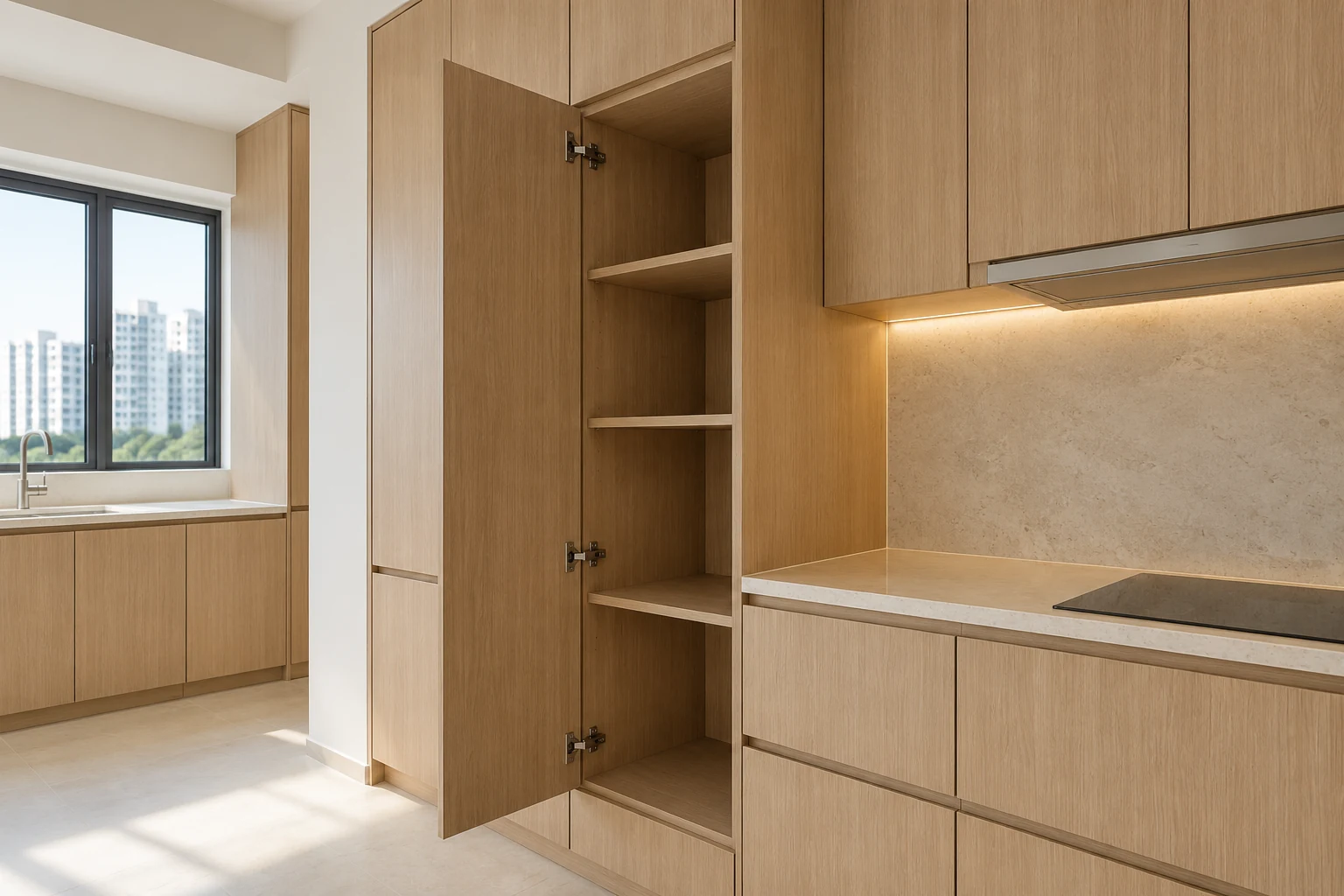
Kitchen cabinet hinges should be selected for the door and the way the cabinet is used. A familiar brand name or soft-close label does not establish that the proposed hinge suits every front, corner or internal fitting.
These eight checks help homeowners ask useful specification questions. They are not hinge-sizing or installation instructions; the responsible fabricator should use the actual manufacturer’s guidance.
1. Identify the door construction
Provide the actual door material, dimensions and relevant assembly information. Have the fabricator assess the appropriate fittings rather than selecting hinges from appearance alone.
A tall front and a smaller upper-cabinet door may need different treatment. Do not infer suitability merely because two hinges look alike or because the same brand appears elsewhere in the kitchen.
2. Explain how the cabinet must open
Show adjacent walls, cabinets and internal drawers on the drawings. Ask whether the proposed movement provides useful access without conflicting with neighbouring components.
An opening angle is meaningful only in the actual arrangement. A wider swing is not automatically better if it creates another collision or does not solve the access problem the user faces.
3. Name the actual fitting
Request the product or system reference and the relevant features included in the quotation. A general soft-close description is not a complete hardware schedule.
Confirm how any selected opening support or closing feature relates to the rest of the assembly. Keep alternatives identifiable so a later substitution is reviewed against the original functional requirements.
4. Have quantity and fixing assessed
Ask the responsible installer to follow product guidance for the actual front and cabinet construction. Blum’s planning information, for example, relates hinge selection to front dimensions and weight; it does not support one universal hinge count.
Do not prescribe a fixing or quantity from a photograph. The homeowner’s task is to require a suitable specified assembly, not improvise the technical detail.
5. Test access to internal fittings
Review drawers, baskets and shelves with the door open. Check whether the proposed hinge and door position allow the selected internal components to operate as intended.
This is particularly useful near corners and narrow passages. A cabinet can look complete when shut yet be inconvenient if its door prevents normal use of the internals.
6. Consider reach and operating comfort
Discuss who uses the cabinet and whether opening effort or reach is a concern. Test a representative system where practical rather than judging only a catalogue description.
Keep the handle arrangement in the same review. Comfortable operation depends on the door, grip and fittings together, especially where the user needs to reach across a counter.
7. Ask about adjustment and replacement
Confirm who adjusts the installation at handover and what information is retained for later maintenance. Ask how a worn or damaged fitting would be identified and replaced.
Do not assume every visually similar replacement will fit. Keep the original hardware reference with the cabinet specification and follow the responsible supplier’s maintenance guidance.
8. Check normal operation at handover
Open and close the agreed doors with the team, including adjacent units where relevant. Review alignment, access and the selected closing behaviour under normal use.
Record concerns and follow-up responsibility rather than attempting unsupported adjustments yourself. Handover should confirm the specified cabinet operates as intended, not merely that a branded hinge has been installed.
Compare the options
| Option | Useful when | Resolve first |
|---|---|---|
| Standard door application | The door and cabinet suit it | Actual product and fixing guidance |
| Special access application | Internals or corners need attention | A coordinated opening arrangement |
| Replacement fitting | An existing hinge needs attention | Identify the original assembly |
A practical planning example
Illustrative example: a pantry includes inner drawers behind a hinged front. The designer checks the door movement and internal drawer access together before the hardware schedule is approved. This scenario demonstrates coordination; it does not specify a hinge model, number or fixing method for another cabinet.
Frequently asked questions
Is soft close a full specification?
No. Identify the fitting and confirm suitability for the actual door and arrangement.
Should every door use the same hinges?
Have the fabricator assess each application using the relevant product guidance.
What should I retain after installation?
Keep hardware references, the cabinet specification and the agreed adjustment or follow-up contact.
Related planning: Kitchen Cabinet Handles: 7 Singapore Buying Decisions · Custom Carpentry Singapore: Built-Ins & Quotation Guide · Wardrobe Internal Layout: 7 Singapore Storage Decisions · Carpentry Quotes: 8 Per-Foot-Run Checks in Singapore.
References
Explore the related decision in Carpentry Handover: 8 Checks After Installation.
Plan your project with Crown Interior Design
Send your floor plan, photographs, intended use and budget priorities. Explore Crown Interior Design’s services and residential projects, then request a tailored quotation. Confirm the scope and any specialist involvement for your actual premises.
For wider planning, explore interior design in Singapore with Crown Interior Design.