
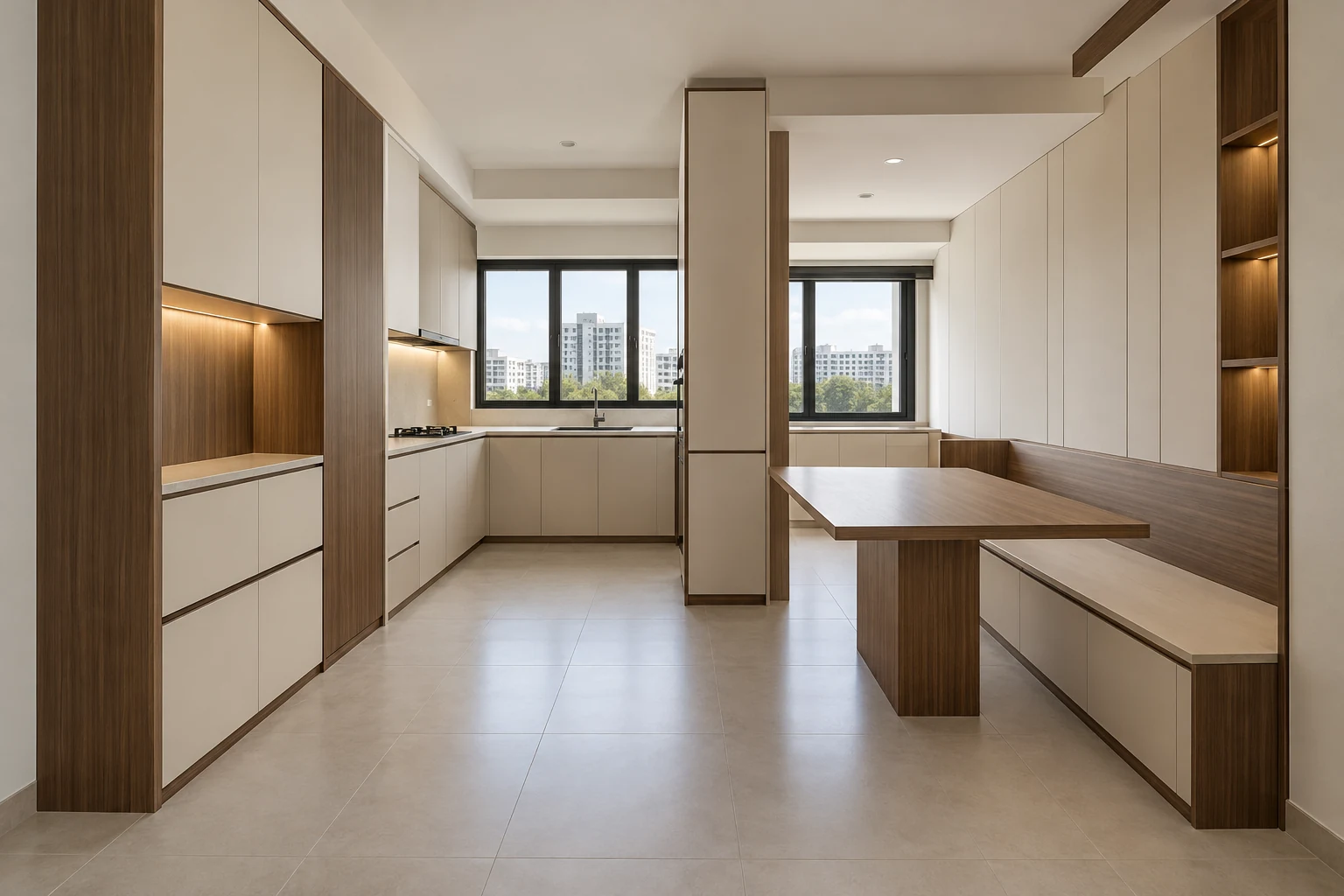
Choosing between Contemporary and mid-century modern? The useful question is what changes in your actual renovation brief. This comparison focuses on fitted cabinetry, surface choices and daily use, rather than treating either style as a fixed package.
Use these eight decisions when discussing an HDB BTO, resale flat or condo proposal with Crown Interior Design. They are planning suggestions, not a fixed specification or a promise that the theme suits every property. Confirm the actual site conditions and quotation before approving work.
The external reference linked below offers another practitioner’s interpretation. Use it for comparison; its projects and specifications are not attributed to Crown Interior Design.
1. Choose the lead geometry
A contemporary brief can use clean continuous planes, while a mid-century-inspired brief may introduce stronger rectangular framing and measured curves. Compare the same fitted wall in both languages. Keep the reference period as inspiration rather than forcing decorative shapes onto every cabinet or creating awkward internal compartments.
2. Test walnut against the floor
A walnut-like tone can give a mid-century proposal depth, but it should be tested beside the existing floor and daylight. A contemporary alternative may use a quieter cream or grey base. Compare large samples so that grain scale and colour variation are visible before approving a whole wall.
3. Translate references into built-ins
Many mid-century references depend on loose furniture. For a fitted-furniture-led project, translate the appeal into door framing, shelf proportions or a fixed sideboard rather than copying a chair silhouette. Ensure the resulting built-in still suits the required storage and does not become a shallow decorative imitation.
4. Control the accent colour
A muted olive or ochre accent can support a mid-century-inspired scheme, while a contemporary scheme may use another restrained contrast. Give the accent a defined location, such as one recessed bay. Repeating it without a plan across several rooms can make future replacements unnecessarily restrictive.
5. Compare handles and edges
Simple metal pulls or carefully proportioned timber grips can reinforce the intended character. Try them on a door sample and check neighbouring drawers for clashes. A contemporary recessed grip is another option, but assess the actual hand clearance rather than assuming an invisible handle is automatically more refined.
6. Set a display rhythm
A fitted sideboard with a small open section can provide a mid-century reference without creating a wall of shelves. A contemporary proposal can make that display more discreet. Confirm what will occupy the opening and where sockets or equipment cables belong before deciding the final arrangement.
7. Check detailing costs
Special timber edging, framed fronts and curved ends can affect fabrication scope. Ask which details are essential to the mid-century interpretation and which can be simplified. Compare against a contemporary option using the same cabinet length and internal fittings so the quoted difference remains understandable.
8. Keep the home current in use
Choose storage dimensions for present-day appliances and belongings, even when the visual references are historical. Confirm ventilation and access requirements with the relevant product information. A convincing theme should accommodate contemporary routines comfortably rather than requiring the household to work around a nostalgic-looking cabinet.
Compare the options
| Option | Useful when | Resolve first |
|---|---|---|
| Contemporary | You prefer the first material and form direction described above | Approve its sample board and fitted elevation |
| mid-century modern | The alternative palette and detail better suit your room | Compare the same storage and functional scope |
| A restrained combination | You like selected details from both | Choose one lead language and resolve the junctions |
A practical planning example
Consider condo owners who enjoy walnut references but prefer a current kitchen layout. This is an illustrative planning scenario, not a completed Crown Interior Design project. Use one walnut-framed fitted sideboard as the mid-century accent and keep the main kitchen geometry practical. Compare that scheme with a quieter contemporary version using the same storage quantities and hardware.
Frequently asked questions
Is Contemporary or mid-century modern cheaper?
Neither label determines the price. Compare cabinet quantities, construction, fittings, finishes, lighting and installation on the same scope. Custom profiles or matched surfaces should be identified separately so that the reason for a difference is visible.
Can both directions work in a Singapore BTO flat?
Either can inform a BTO brief, but the actual layout, daylight, storage needs and permitted works must be reviewed. Keep the comparison tied to your floor plan. Do not assume that a reference image from another home proves the same layout or alterations are suitable.
Can I combine these themes?
Yes, if the combination has a clear lead palette and a small number of secondary details. Ask for a coordinated elevation and sample board showing the junctions. If the references demand conflicting profiles or too many finishes, simplify the fixed elements first.
Related planning: Contemporary Interior Design: 7 Singapore Planning Choices · Mid-Century Modern Interiors: 7 Singapore Home Choices · Renovation Material Selection: 6 Sample Approval Checks.
References
Explore the related decision in Transitional Interiors: 8 Singapore Design Decisions.
Plan your project with Crown Interior Design
Send your floor plan, photographs, intended use and budget priorities. Explore Crown Interior Design’s services and residential projects, then request a tailored quotation. Confirm the scope and any specialist involvement for your actual premises.
For wider planning, explore interior design in Singapore with Crown Interior Design.