
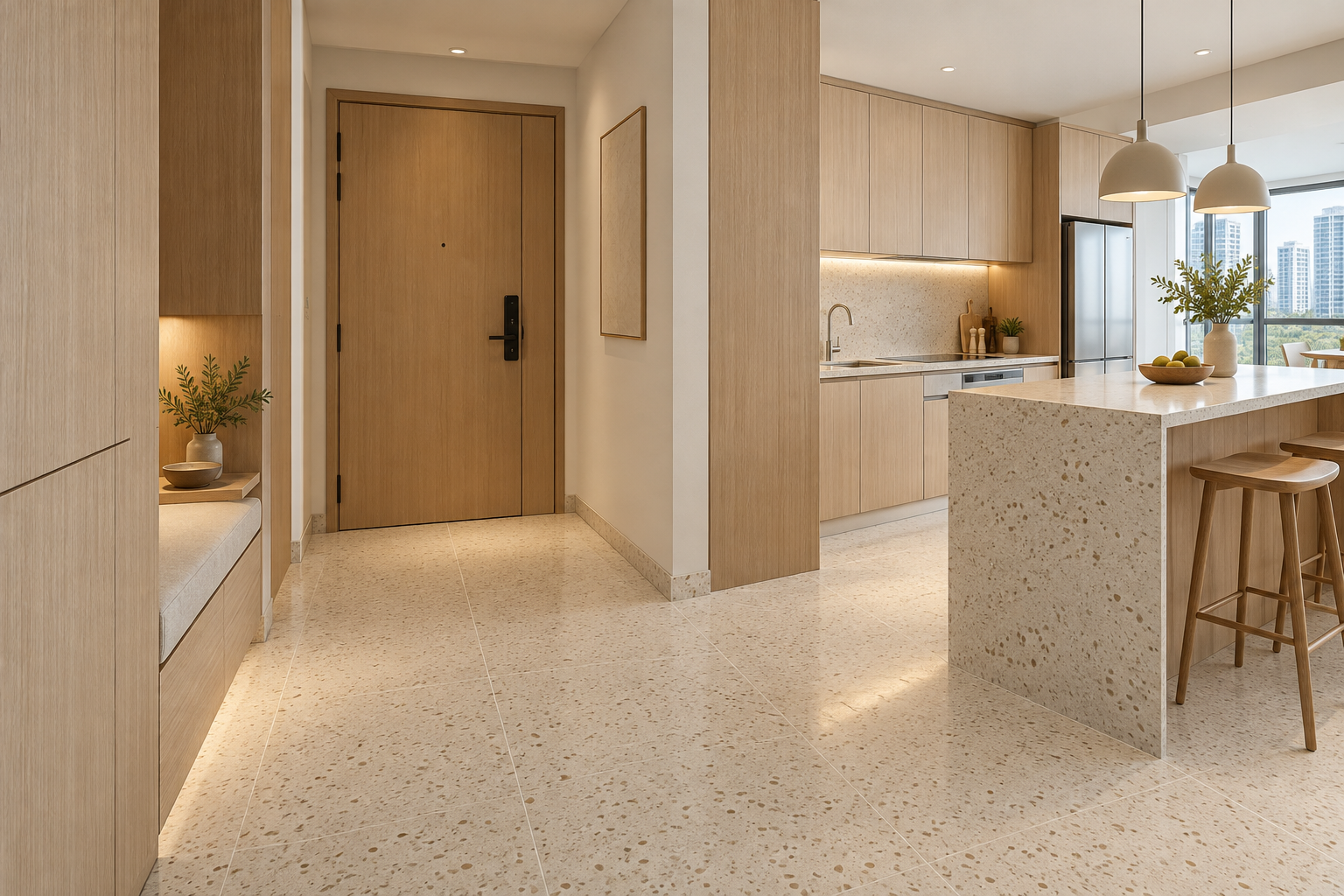
Terrazzo tiles can give a Singapore interior a distinctive speckled surface, but the appearance does not identify the complete product. Actual terrazzo and a ceramic or porcelain tile printed with a terrazzo-like pattern can require different specification and care. Start by naming the material rather than ordering from a small photograph.
This guide focuses on selecting and coordinating a tile finish for your renovation. It complements a general HDB flooring guide by examining the terrazzo pattern and product decision. The substrate, location and proposed installation still need assessment by the responsible team.
1. Distinguish the product from the appearance
Ask whether the sample is actual terrazzo or a terrazzo-look tile and obtain the exact product information. The shared speckled appearance does not establish identical composition, thickness, maintenance or suitability. Request the supplier’s application and care guidance. Avoid transferring a performance claim from one category to another. A clear specification is more useful than a quotation describing only a terrazzo design without identifying what will actually be supplied.
2. Review the pattern at room scale
A few large chips can look very different across a whole floor from fine, closely spaced speckles. Place several actual samples together and view them from the normal distance. Ask about variation or repetition in the selected product. Check the relationship to patterned worktops, timber grain and existing furniture. If several surfaces compete, a smaller area or quieter pattern may give the room a more deliberate hierarchy.
3. Choose the location before the finish
A wall accent, dry living-room floor and bathroom floor create different demands. Ask the relevant supplier and installer to confirm suitability for the exact use. Do not infer slip performance, moisture behaviour or cleaning tolerance from appearance. Where a technical rating matters, request relevant evidence for the named product. The decorative choice should follow the practical application rather than be used to justify installing one attractive sample everywhere.
4. Plan joints and transitions
Review tile dimensions, the proposed layout and where cuts fall at doors and cabinet edges. A speckled pattern does not make joints disappear. Compare grout appearance with the actual sample and ask how transitions to adjacent finishes will be resolved. Show thresholds and retained items on the same drawing. The perimeter details often affect the finished result as much as the central area shown in a showroom display.
5. Assess the existing surface and work method
Have the responsible team examine what is already installed and what the proposed work involves. Retention, overlay and replacement have different interfaces and conditions. Do not assume a new finish can be added without affecting doors, levels or adjacent cabinetry. Check the applicable HDB or building requirements. The quotation should identify preparation, removal where required and making good rather than presenting a tile supply rate as the whole project.
6. Clarify care and repair expectations
Ask how the chosen product is cleaned and whether any specific treatment is required. Do not apply generic stone-care advice to every terrazzo-look tile, or assume every actual terrazzo surface has the same finish. Discuss spare material and replacement expectations. A later tile may not match an aged installation perfectly. Keep the product identifiers and care instructions with the handover records so maintenance is based on what was installed.
7. Compare a complete specified installation
Use the same area, preparation, product, layout and junction details when reviewing quotations. Include skirtings or edge pieces if needed and identify owner-supplied material separately. Crown Interior Design can help coordinate the selected pattern with the wider palette and actual site. A convincing result comes from the right amount of pattern and clear installation details, not from treating the word terrazzo as a complete specification.
Compare the options before committing
| Option or decision | Useful when | Check before approval |
|---|---|---|
| Actual terrazzo product | Its specific material character is desired | Composition, finish and product care |
| Terrazzo-look tile | A particular printed pattern suits the room | Named tile, variation and application |
| Small accent area | The scheme already has other strong finishes | Edges and relationship to adjacent surfaces |
A worked planning example
An illustrative BTO owner likes a bold speckled floor and a heavily patterned kitchen counter. Reviewing several full-size tile samples may suggest a finer floor pattern or a smaller accent area. The installer then checks the proposed work and transitions. This example is about balancing the scheme; it does not state that every tile is suitable for every room or that an overlay is permitted.
What to bring to the design discussion
- Exact product and several samples
- Proposed location and current floor information
- Layout, joints and transition details
- Care information and complete installation scope
Frequently asked questions
Are terrazzo and terrazzo-look tiles the same?
No. Identify the actual product and its specification rather than relying on the shared appearance.
Can I use one tile throughout the home?
Only where the selected product and installation are suitable for each location. Check the actual requirements.
Will speckles hide every mark or joint?
Do not assume so. Review samples, joint details and the expected care regime.
Plan your project with Crown Interior Design
Send your floor plan, current photographs, intended use, timing and budget priorities. Explore Crown Interior Design’s design and renovation services and residential projects, then request a tailored quotation. The proposed scope and any specialist involvement should be confirmed for your actual premises.
Continue planning: HDB Floor Tiles Singapore: 8 Renovation Decisions · 8 Kitchen Countertop Checks Before You Order in Singapore · Contemporary Interior Design: 7 Singapore Planning Choices.
For a separate practical checklist, see RenoLinkUp’s interior design mock-up checklist.