
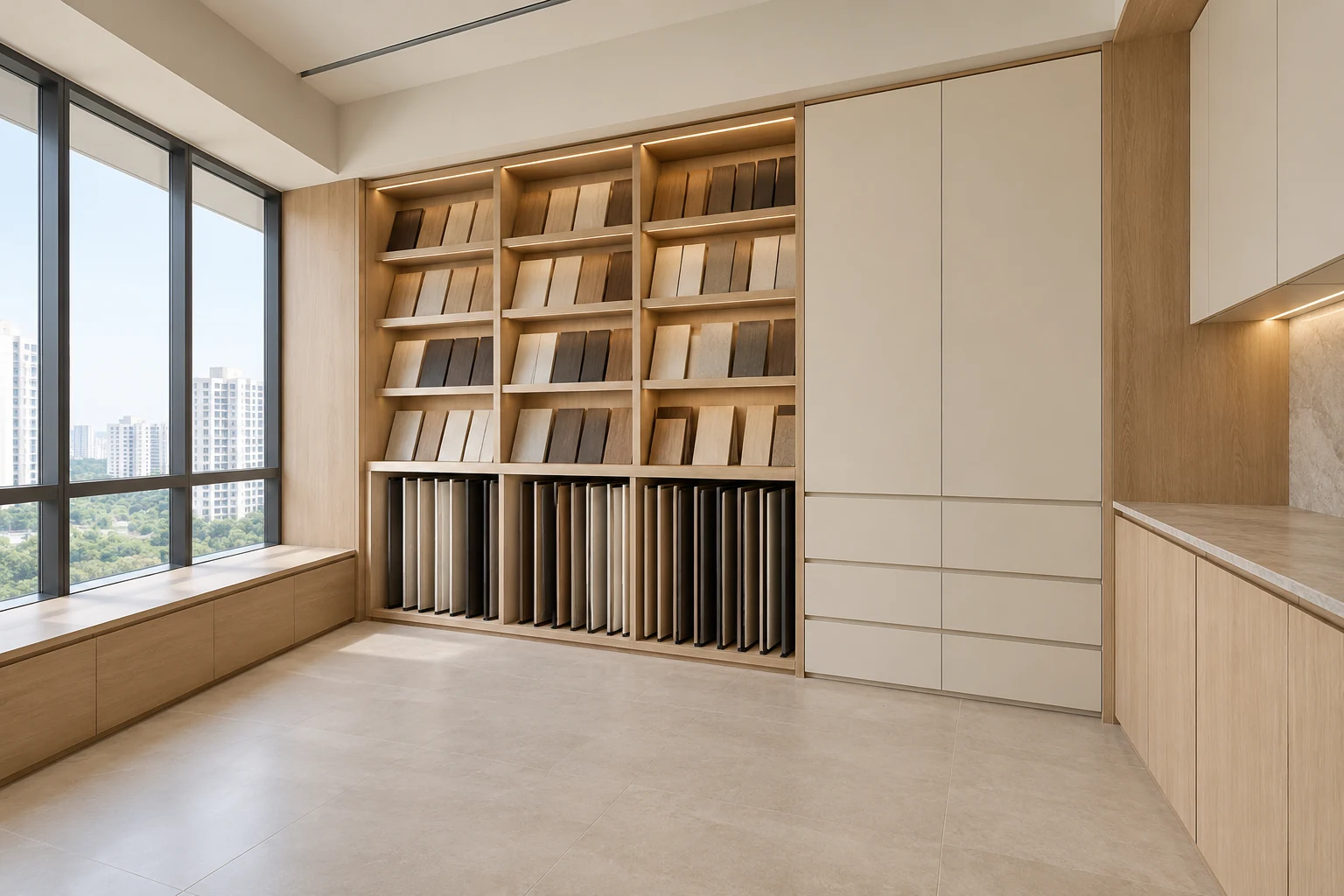
A showroom sample library should make products easy to compare and return. Its fitted cabinetry must accommodate the actual boards, panels or other samples, not just create an attractive background for consultations.
These eight checks help a business define a sample-storage brief. They do not certify shelving capacity or endorse a particular supplier; construction and specialist requirements need appropriate assessment.
1. Inventory sample formats
List boards, folders, panels and other items with their actual dimensions and handling needs. Separate daily-use samples from reserve or discontinued ranges.
A generic grid of shelves can waste space when formats vary. The cabinet design should follow the inventory rather than force every supplier’s sample into the same compartment.
2. Plan how customers compare products
Describe whether staff retrieve samples, customers browse directly or a combination is intended. Map the path from selection to discussion and return.
Storage should support the consultation rather than interrupt it. An impressive wall can be less useful if staff repeatedly need to move other items to reach a requested sample.
3. Choose storage by handling method
Compare shelves, slots, drawers or assessed pull-out systems for the actual sample types. Consider how users lift and return items safely and comfortably.
Do not choose a mechanism only because it looks sophisticated. The correct arrangement depends on the contents, reach and the responsible supplier’s assessment of the complete assembly.
4. Have loading and fixing assessed
Provide the intended contents to the fabricator and have construction, supports and fixing confirmed. Sample collections can differ significantly in weight and handling.
Avoid transferring a load claim from another showroom or cabinet system. The actual installed arrangement needs its own appropriate specification and relevant professional review.
5. Keep identification and return simple
Agree a system for identifying ranges and returning samples to their location. Coordinate any labelling or record method with the business’s operating routine.
Do not let a highly uniform front conceal a difficult retrieval process. A small improvement in organisation can be more useful than adding storage volume without a clear way to use it.
6. Provide for sample loans and updates
If samples leave the showroom, define how staff issue, record and receive them. Identify where returned items wait for checking and where discontinued material is held.
These are business-process decisions, not tasks the cabinet alone can solve. Design the relevant storage around the agreed process rather than assuming staff will invent one after installation.
7. Review lighting and viewing conditions
Discuss how materials are viewed in the showroom and how lighting affects comparison. Have relevant electrical work assessed by the appropriate professional.
Do not promise that a sample will look identical in every customer’s home. Encourage physical review in the project’s intended context and keep the sample-library presentation distinct from a product-performance claim.
8. Confirm the complete fitted specification
Record compartments, hardware, finishes, access and installation responsibilities. Review a representative module or detail where useful before approving a large repeated system.
At handover, test retrieval and return with the actual sample formats. Keep drawings, product references and follow-up contacts so future collection changes can be reviewed against the installed cabinet.
Compare the options
| Option | Useful when | Resolve first |
|---|---|---|
| Open sample shelves | Direct viewing suits the formats | Reach and an orderly return system |
| Slots or drawers | The formats need defined handling | Usable dimensions and loading |
| Assessed pull-out display | A particular collection benefits from it | Complete assembly and maintenance |
A practical planning example
Illustrative example: a materials showroom stores several suppliers’ boards in different formats. The team inventories them before dividing the fitted wall into slots and drawers, then tests retrieval and return. Admira’s Library is a separate local showroom reference for inspiration, not a Crown Interior Design project or proof that its arrangement suits another collection.
Frequently asked questions
Can I copy a showroom cabinet from a photograph?
Use it for direction, then assess your actual sample formats, loading and operating process.
Should all samples stay on display?
Decide which ranges need direct access and which can be stored separately.
What should be tested at handover?
Review retrieval, return, relevant mechanisms and the agreed identification process with actual sample formats.
Related planning: Showroom Interior Design Singapore: 8 Planning Decisions · Custom Display Cabinets: 7 Singapore Design Decisions · Renovation Material Selection: 6 Sample Approval Checks · Retail Display Cabinets: 8 Singapore Buying Checks.
For a separate reference, use RenoLinkUp’s showroom sample-loan counter checklist.
References
For firm selection, use the award-winning office interior design evaluation guide to check the recognised work, credited recipient and relevance to your own appointment.
Explore the related decision in Carpentry Handover: 8 Checks After Installation.
Plan your project with Crown Interior Design
Send your floor plan, photographs, intended use and budget priorities. Explore Crown Interior Design’s services and commercial projects, then request a tailored quotation. Confirm the scope and any specialist involvement for your actual premises.
For wider planning, explore interior design in Singapore with Crown Interior Design.