
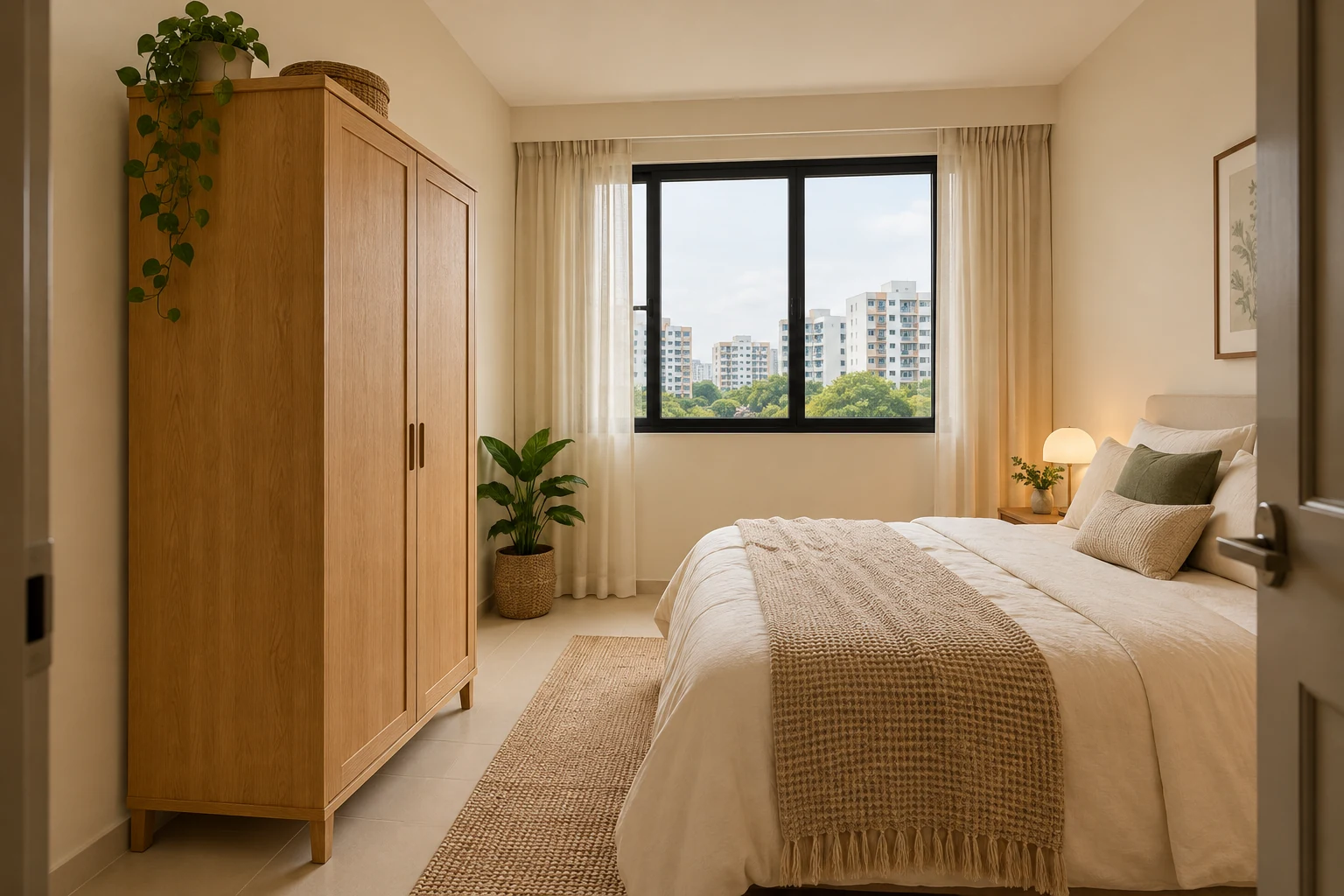
A built-in wardrobe and a freestanding wardrobe solve different problems. The right choice depends on the room, belongings and likely future changes, not simply which option looks more seamless in a photograph.
These eight decisions help you compare both approaches in a Singapore home. Use actual product dimensions and an appropriate installation assessment. Neither option is automatically better value or suitable for every bedroom.
1. Start with the storage inventory
List hanging clothes, folded items, luggage and other belongings before choosing a cabinet type. Separate daily-use items from occasional storage. Compare how each option accommodates the same inventory.
Avoid judging capacity from external width alone. Internal layouts, usable openings and compartment access can differ substantially. A wardrobe should support the way you dress and store belongings rather than merely fill the available wall.
2. Check the furnished room
Show the bed, bedside furniture, doors and walking route alongside the proposed wardrobe. Include opening movement for doors and drawers. An item can fit the wall and still make ordinary bedroom use awkward.
Compare actual dimensions rather than an assumed standard unit. For a ready-made system, use the selected product’s information. For fitted work, confirm the intended cabinet depth and site conditions before treating the layout as final.
3. Understand the fit and visible gaps
A fitted cabinet can be designed around a particular space, while a freestanding unit has its own defined dimensions. Discuss the resulting ceiling, wall and floor junctions and how they will look in your room.
Do not assume a ready-made unit will create a built-in result without additional work. Equally, do not commission full-height joinery unless its tailored fit solves a useful problem for the household.
4. Compare internals rather than door style
Review hanging arrangements, drawers, shelves and any proposed accessories. Identify which components are adjustable and how the user reaches them. The external finish does not establish how convenient the storage will be.
Keep the comparison on the same belongings and access needs. Adding several accessories to one option while pricing a basic version of the other can make the purchase comparison misleading.
5. Consider future room changes
Explain whether the room may become a study, guest room or another household member’s bedroom. Movable furniture may offer flexibility, while fitted storage may suit a stable layout and specific dimensions.
Do not assume any freestanding product is easy to move repeatedly. Check its assembly, handling and relevant safety instructions. Discuss the practical consequences of change rather than relying on a general claim that one option is permanently future-proof.
6. Check installation and safety requirements
Have the responsible installer assess the actual location and follow the selected product’s installation requirements, including any necessary fixing. A freestanding appearance does not mean an item can safely be left unsecured where fixing is required.
For fitted work, confirm relevant service access and junctions before fabrication. Keep technical installation decisions with the appropriate parties rather than choosing a fixing method from a reference photograph.
7. Compare complete delivered costs
Include delivery, assembly or installation, internal fittings and any making good. If an old wardrobe is removed, identify dismantling, disposal and exposed finishes. A product price and a completed replacement scope are different commitments.
Ask what is included in any customised or fitted-look adaptation. Compare confirmed proposals on the same room and storage brief before deciding which option offers the better fit for your priorities.
8. Review maintenance and follow-up
Ask how doors, drawers and selected fittings can be adjusted or replaced, and what product or workmanship terms apply. Keep actual product details and care guidance after installation.
At handover, check the agreed internal arrangement and normal operation with the team. Record outstanding items and follow-up responsibility. A visually coordinated room should also contain storage that can be used and maintained comfortably.
Compare the options
| Option | Useful when | Resolve first |
|---|---|---|
| Built-in wardrobe | A tailored fit solves a defined room need | Measured scope and fixed interfaces |
| Freestanding wardrobe | A selected product fits the room and use | Actual dimensions and installation instructions |
| Adapted modular system | A system arrangement suits the brief | Extra fitting work and its boundaries |
A practical planning example
Illustrative example: a household expects a bedroom to change use in several years. They compare a freestanding wardrobe with fitted storage using the same clothing inventory and bed layout. The selected option reflects access, installation and future-use priorities rather than an assumed saving. This scenario does not recommend a particular retailer or establish that one wardrobe system suits every room.
Frequently asked questions
Are freestanding wardrobes always cheaper?
Compare the complete selected product and installation with the fitted scope. Internals and associated work affect the total.
Do freestanding wardrobes need fixing?
Follow the actual product’s safety and installation requirements with the responsible installer.
Which is best for a small room?
Test actual dimensions, opening movement and storage access. There is no universal answer based only on room size.
Related planning: Built-In Wardrobe Singapore: Cost, Design & Quote Guide · Sliding vs Hinged Wardrobes: 7 Singapore Buying Checks · Wardrobe Internal Layout: 7 Singapore Storage Decisions · Custom Carpentry vs Loose Furniture: 6 Buying Checks.
References
Explore the related decision in Renovation Site Measurements: 8 Pre-Order Checks.
Plan your project with Crown Interior Design
Send your floor plan, photographs, intended use and budget priorities. Explore Crown Interior Design’s services and residential projects, then request a tailored quotation. Confirm the scope and any specialist involvement for your actual premises.
For wider planning, explore interior design in Singapore with Crown Interior Design.